John Lorenz is talking with Communications Coordinator, Virginia Gordon
Hometown and Background
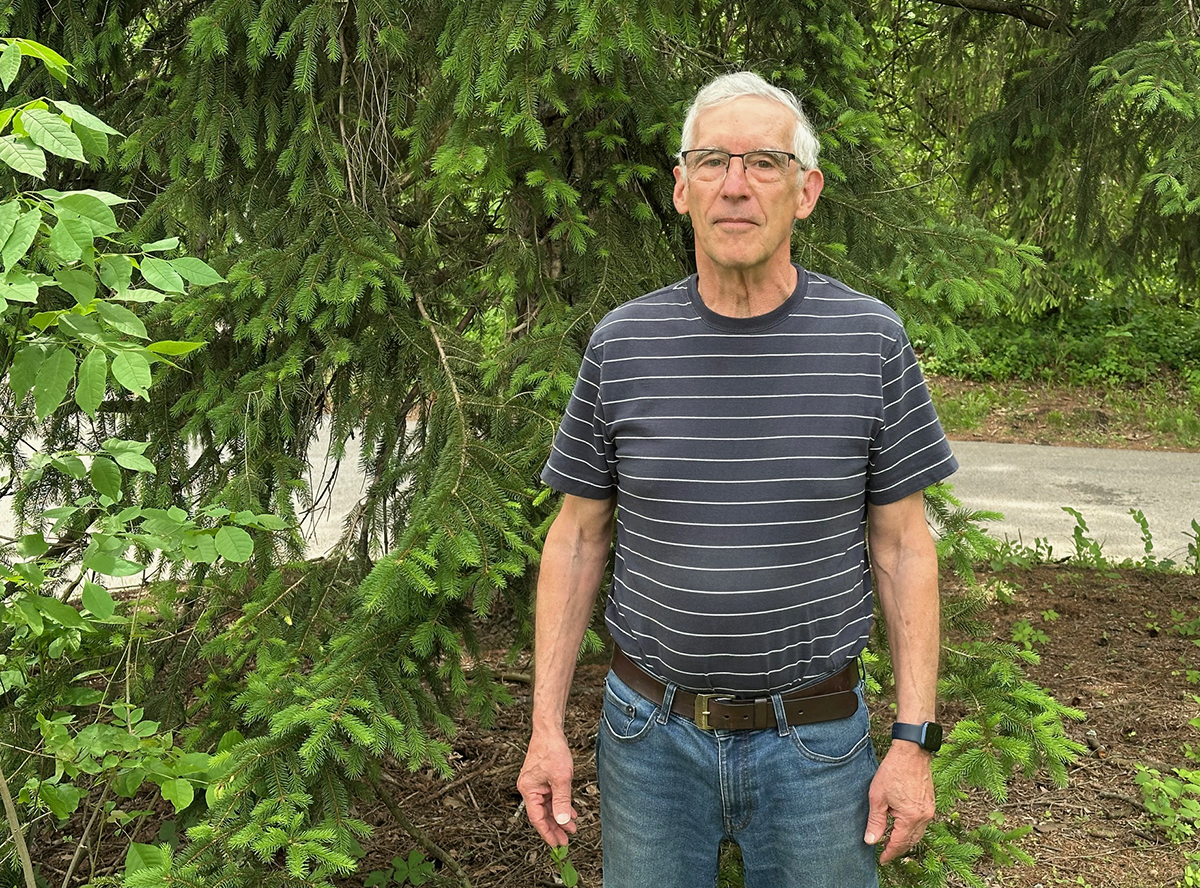
I grew up in Grandview Heights, between Upper Arlington and Downtown Columbus. I was the third of seven kids. I have two older brothers, two younger brothers, and two younger sisters. During my last three years at high school, I volunteered as a counselor for my high school’s spring outdoor education camp for 6th graders, which was a five-day program at Camp Ohio. I assisted the teacher doing stream study classes and using seines to catch fish. That would become a life-time interest for me. I graduated from Grandview Heights High School in 1974 and then went to Muskingum College, although only for one year. I had considered going to OSU, but Muskingum College is smaller and seemed to offer some more personal teaching opportunities, which appealed to me. I thought I had an interest in botany and already had a great love of nature. My year of study at Muskingum College was mostly general education, but I had a shock when I spoke to a college guidance counsellor about my interest in becoming a naturalist as a possible career path. She couldn’t find ‘naturalist’ as an option for study. So I went to OSU the following year. My field of study was Environmental Interpretation and my major was Natural Resources.
As a college student, I worked part time for my brother Michael’s business, Lorenz Electronic Repairs. We repaired or rebuilt electronic keyboards and electronic organs. We even restored a few church organs, as long as they were electronic and not a mechanical pipe organ. I still continued volunteering, now as part of the teaching staff with my Grandview’s Outdoor Education programs, which added a three-day 5th grade camp. Everything seemed to be going well, and then Michael got an offer to work for an organ dealer in Cincinnati. I was a senior at OSU, but Michael asked me to take over his business. I agreed to take on the business and I was committed to it. The organ dealer I did repairs for had a big project to install a Baldwin church organ in Marion and to meet the deadline I sometimes worked after classes and most of the night on it, finally getting home at 4:30am one time. I had a midterm exam in General Accounting later that morning and I did not do well on that test!
I graduated on time from OSU in 1978, spent six weeks in the summer working as the naturalist for the 4-H camp at Tar Hollow State Park and continued with the electronic repair business on the days I had off. The organ repair business became my full time job when camp ended. Meanwhile, in the spring, I continued to be on Grandview’s Outdoor Education program which is how I met my wife, Karen. By 1983, desktop computers were becoming more popular and the home organs were not as popular. I got wind at an organ seminar about a company in Delaware Ohio that needed help repairing their Commodore 64 computers. I could do board level repairs on the computers, as chip failure was more common then. I became their service department and shuttered the organ repair business. This company, Earthrise Micro Systems, opened new outlets in Columbus and started selling other computer brands. We started networking computers in the early years of linking computers to a fileserver. I became a Certified Novell Engineer, or CNE. I was repairing or installing anything attached to a computer. Earthrise folded in 1991 but I had made friends, via Friday night volleyball, with the owner of another business that networked computers. I was immediately snatched up by Lifeline Computing. No interview took place. Lifeline was eventually purchased by Lantec Computing, also a networking company. Unfortunately for Grandview’s Outdoor Education program, when I started working for Lifeline I was no longer able to take time off from work for their camps. But I had already become a volunteer for Metro Parks so I was still involved in nature.
In 1997 I was hired away from Lantec and split my time between two different companies, managing the computer network for the Heinzerling Foundation and doing the same for Hirschvogel Incorporated, a mid-size cold forging plant, and manufacturer of transmission components for autos and tractors. Both companies ran their computer networks on the Novell system. It was a client from Earthrise who recruited me for Hirschvogel. In December 1999, Hirschvogel needed me full-time with them, and the opportunity was too good to decline. So I sadly departed from Heinzerling and worked full-time at Hirschvogel until I retired in January 2016. In the summer of 2016 I took a seasonal maintenance position at Battelle Darby Creek Metro Park. The park manager, Kevin Kasnyik, knew me from my volunteer work at the park. I loved that job.
Why I volunteer at Metro Parks, what I do and what I love most about it
Volunteering has been an important part of life for me since those early counselor sessions for Grandview Heights’ outdoor education camps. I continued volunteering with them until 1992. They added a 3-day program for Fifth Graders at Camp Oty’okwa in the Hocking Hills. I met my future wife, Karen, at one of these camps. She was there as one of the Grandview Elementary School teachers. About a year later, we started dating and three months after that we became engaged. We married in March 1981. Our son Mark was born nine months later.
I didn’t know the Metro Parks all that well before 1989. While studying at OSU we had done some field classes at Highbanks and we also did a class field trip to Blacklick Woods, before the nature center was built. The nature center was in the planning stages, and we were asked to give our thoughts and suggestions on the plans. I recall being leery about the one-way glass looking over the pond, and feared the highly reflective surface would cause problems for birds and lead to potential collisions. Some years later, I noticed my thoughts were recognized (probably independently) and action was taken to prevent bird collisions. On our visit we met the park district’s head naturalist, Gary Moore. The pond behind what would eventually become the nature center was well frozen over and the class was standing on the ice when we all heard a loud cracking sound. We quickly spread out in a panic, but I recall Gary Moore being very calm about it and he did not move. “Ice cracks,” he said. “But it won’t break.” And it didn’t.
My introduction to volunteering at Metro Parks came in 1989. My family had just moved to our current Upper Arlington house and I saw an article in the local paper about upcoming events at Metro Parks. One of them was a seining program at Battelle Darby Creek Metro Park. I already loved seining from camps, and I thought the program would be a great introduction to it for my then 7-year-old son, Mark. We went to the program, and that’s when I met Mac Albin. He was the naturalist at the park then, and I was hooked by his enthusiasm and commitment. I started coming to all of Mac’s programs and loved all of them, though I especially enjoyed his canoe floats, or what he called his BYOB programs, which meant Bring Your Own Boat. Talk about a menagerie of boats! In those days, Metro Parks didn’t have its own fleet of canoes or kayaks for visitors to use. I started helping Mac at his programs two or three times a month. Then I learned that there was an official Metro Parks volunteer organization, and that it was run by Gary Moore.
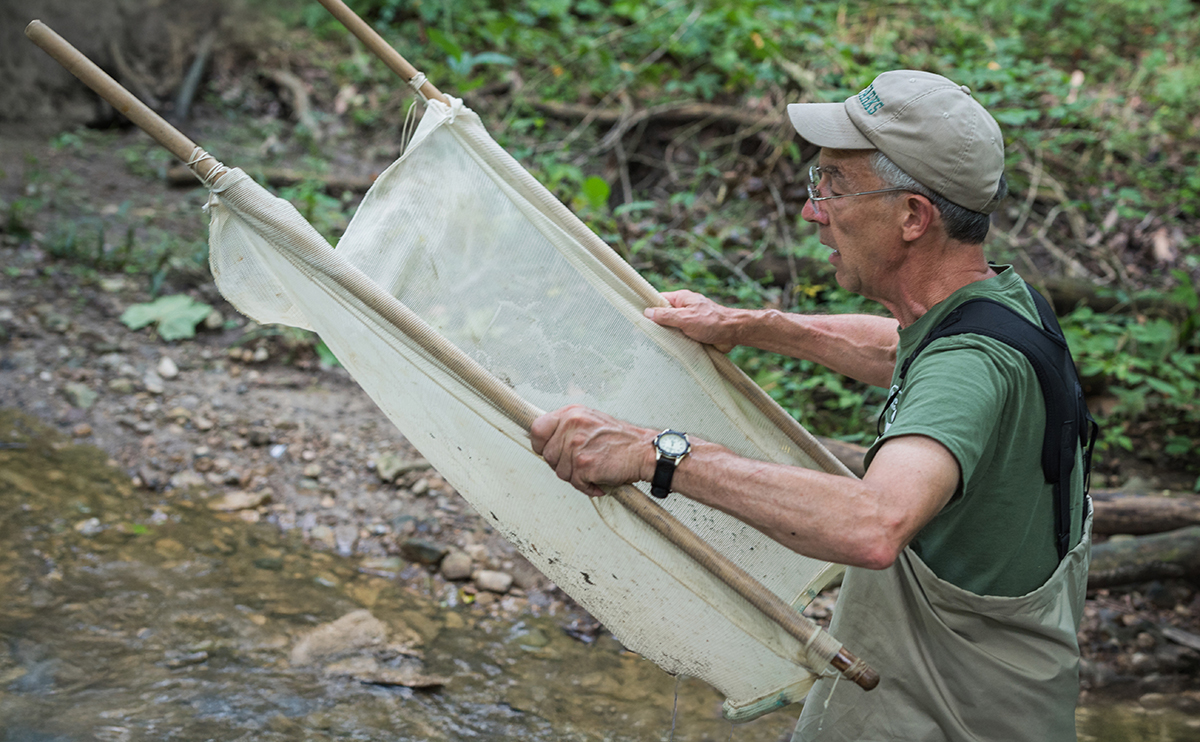
I signed up as an official volunteer, and did most of my volunteering at Battelle Darby Creek, although I also volunteered at other parks. There were only six volunteers at the park at the time. I loved talking to the people who came to the programs and sharing my knowledge with them. As well as the canoe floats, and the seining programs, we did mussel surveys and a number of late-evening programs where we baited trees with a decaying fruit substance to attract moths.
I also volunteered for the regular Stream Quality Monitoring workshop programs, which Metro Parks did in conjunction with the Ohio Department of Natural Resources’ Scenic Rivers program. We held these at the Olentangy River in Highbanks Metro Park, as well as at Big Darby Creek in Battelle Darby Creek Metro Park. We used seines to catch macroinvertebrates, which, based upon what kind of macroinvertebrates we found, gives a strong indication on river quality and the health of the water.
I’ve always been interested in making things. I have a woodworking shop at home which enable me to manufacture what I dream up. Mac had been given a hand-made plastic box for showing fish, amphibians and insects to visitors. It was made with thick plastic plates, glued together with silicone rubber (think fish tank). I thought I could improve on the design and make something better in my shop. This became a labor of love for me. I made an 11 inch wide by 8 inch high by 3 inch deep box using acrylic sheets, and used a solvent glue so the joints were fully transparent. I fire polished the edges, so they were perfectly smooth. After a short time I precisely cut slots in the panel to add a sliding lid and after a few years I started gluing guides inside the box to insert removable dividers. Mac, and later on, Tim Taylor, found these of great value. Tim replaced Mac as the Battelle Darby Creek park naturalist and Mac become the Metro Parks aquatic ecologist. The dividers enable people to see similar but different species of fish. The lid prevented the water from splashing when being passed among park visitors, Eventually I improved my own design by adding a nub that held the dividers in place when the lid was removed and the box turned over to return the fish to Big Darby Creek. Experience had shown us that the dividers, if they got into the water, were almost impossible to find and retrieve, as water and acrylic have the same reflective index. Metro Parks would buy the viewing boxes from me, and I would charge just enough to cover my costs. Adding a nub on the sliding lid prevented if from sliding off accidentally, which had happened often. The boxes also work well on land insects. The addition of a screen in the lid allowed for air flow for longer times of captivity.
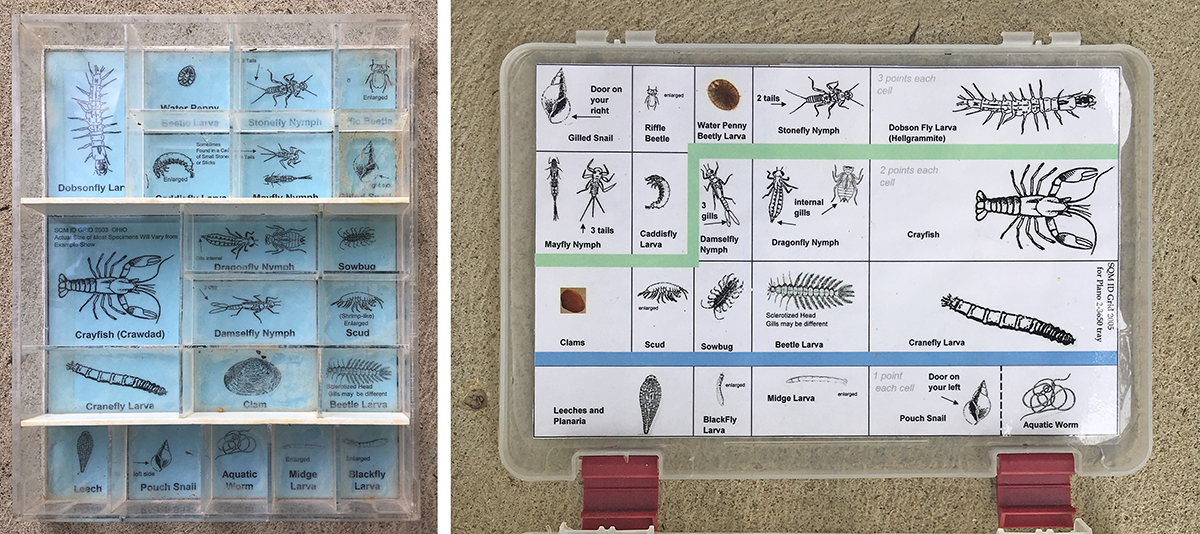
Because of my work at SQM workshops I saw a need for something that helped people ID what they were finding. I invented a watertight sorting tray to identify and track the macroinvertebrates found in the Stream Quality Monitoring workshops. This uses plastic strips glued to a base to create cells of different sizes, and on different rows, and a laminated sheet is held in place underneath, with names and pictures of the types of critters to go into each cell. These proved to be very popular with Metro Parks naturalists and ODNR people. (I saw one on display at the OSU Museum of Biodiversity Open House.) They take me about six hours each to make in my shop. I devised a way to use an inexpensive Plano Tray Tackle Box. Because of my deep interest in Stream Quality Monitoring, I have taken the US EPA exams and qualified as a Level 2 Certified Benthic Macroinvertebrates Data Collector (benthic means bottom dwelling, and these are the critters that tell us about the health of our local streams).
I used to raise brown house crickets and was able to produce around 3,000 adult crickets a month, which I donated initially to Battelle Darby Creek (before the building of their nature center) and then to the Ohio Wildlife Center and Stratford Ecological Center, to help feed some of their animals. When Battelle Darby Creek opened its nature center in 2011, I was able to supply them with all the crickets they needed to feed the animals in the nature center’s living stream. I also gave crickets to Highbanks and other parks, to feed their ambassador animals in their nature centers. I spent many hours volunteering at the Battelle Darby Creek Nature Center, and would show visitors around the living stream, talk about the animals in the stream, why mussels are important to have, and answer any visitor questions.
Another area that interested me greatly was the Metro Parks’ salamander surveys in spring. This led me to volunteer at Glacier Ridge Metro Park for their vernal pool surveys and programs. I started that when Chrissy Hoff was the naturalist at Glacier Ridge. I was on a team that surveyed the multiple vernal pools. Vernal pools shrink as the trees leaf out. We would monitor the changing pool dimensions, what salamanders and other amphibians we found there, and what other animals lived there. I wanted to know what the salamanders were eating. No food, no salamanders. This led to the development of the SpoonNet. Think of a pencil with a stiff 1-inch net on the end. The nets have a plethora of uses but the main use is capturing live small aquatic animals. Park visitors love these. Everybody loves to look through a tray of water collected by the seine to see what they can find.
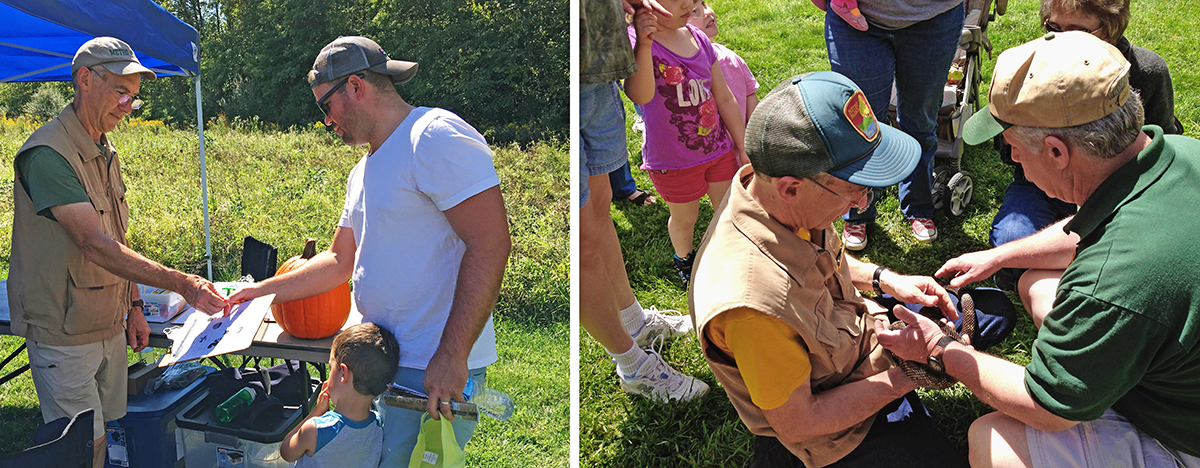
I continued to be very active with the Metro Parks resource management team, especially on their invasive plant removal. We shift to harvesting of prairie seeds, in late August to early October. The seeds are collected, cleaned and sorted by long-time Metro Parks resource management technician, Gordon Mitchell, and then shared for planting in Metro Parks or shared with other organizations.
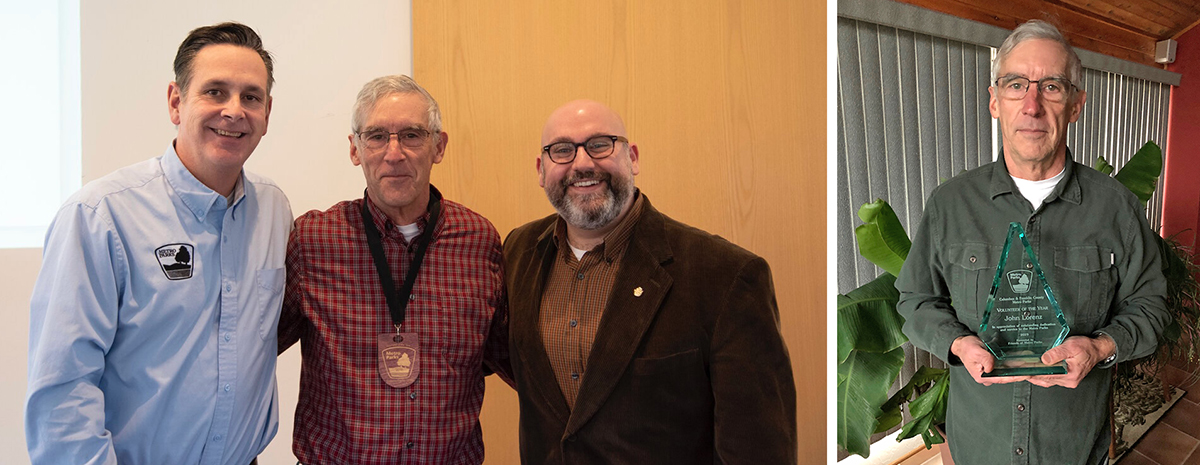
I’ve been a volunteer at Metro Parks now for 35 years. My wife Karen also signed up as a volunteer in 2011. In January 2020, at Metro Parks’ Annual Volunteer Appreciation event, I was selected for the Volunteer of the Year Award for both Battelle Darby Creek and Resource Management, and also received the award for All Metro Parks. And then, just a couple of months later, Covid changed the world.
I’ve changed the type of volunteering I do since COVID hit. Both Karen and myself are over 60, and as we like to travel, especially to visit our daughter who lives in Germany, and trips to Hawaii in January, we had to make a change. To help protect us against any possible exposure to Covid, I now rarely do public programs inside the nature centers. Most of my volunteering now is on the invasive removal team. There’s about 15 regulars on the team and we move around from park to park, removing invasives such as autumn olive, callery pear, Japanese bush honeysuckle, and burning bush. We’ve had reports that crimson berry, another invasive plant, is beginning to take over parts of Clear Creek, so a visit to that most southerly of our parks will be coming up on our schedule in the not too far-off future.
I stopped raising crickets in 2021, but to maintain the supply of crickets for the Battelle Darby Creek Nature Center, I taught park naturalist Debbie how to raise them. I gave Debbie the equipment she needs and it is working out well, and has kept the living stream animals happy and fed.
Of all the many activities I’ve been involved in as a Metro Parks volunteer, I’d say two stand out as my favorites. The first would be the canoe floats, especially in the early days when it was bring your own boat. Early on we would often participate in these as a family, with me, Karen and our sons Mark and Jason, and our daughter Amanda. My other favorite activity was when we went out mussel noodling, either for survey purposes, or as a public program. Mike Hogarth, a professor at Otterbein who came out to a lot of these programs, taught me a lot about mussels and their life cycle, so that I could eventually talk authoritatively to visitors about these fascinating animals and their importance to the health of our waterways. The most exciting mussel noodling session came when I was with Sue Chenowith, who, with me, was one of those six Battelle Darby Creek volunteers back in 1989. She managed to noodle in a sandbar in Big Darby Creek and found a northern riffleshell, a federally-endangered species of mussel.
Outside of volunteering, Karen and I like to go hiking in the parks, especially on the many varied trails at Battelle Darby Creek. We also like to participate in the Winter Hikes every year.
My favorite Metro Parks story that includes a positive or memorable visitor interaction
I have a trio of interactions, a couple of which I found to be very amusing at the time, and the first one relates to those crickets I used to raise. When we brought out the crickets at feeding time, we would invite visitors to take one and drop it into the living stream to feed one of their favorite animals. Young kids loved doing this, but kids around 8 years old are leery about touching the crickets. Younger kids and older kids usually have no problems. One day, after working with the crickets in the basement, I brought up a couple of crickets that had molting issues. A young boy aged about 14 was at the living stream and I asked if he would like to feed a cricket to a fish. He picked up the cricket and dropped in into the living stream. Then immediately retrieved it and popped it into his mouth and ate it! Crickets are quite edible, it is just not something North Americans do. I found out later his mental age was several years younger. Lesson learned!
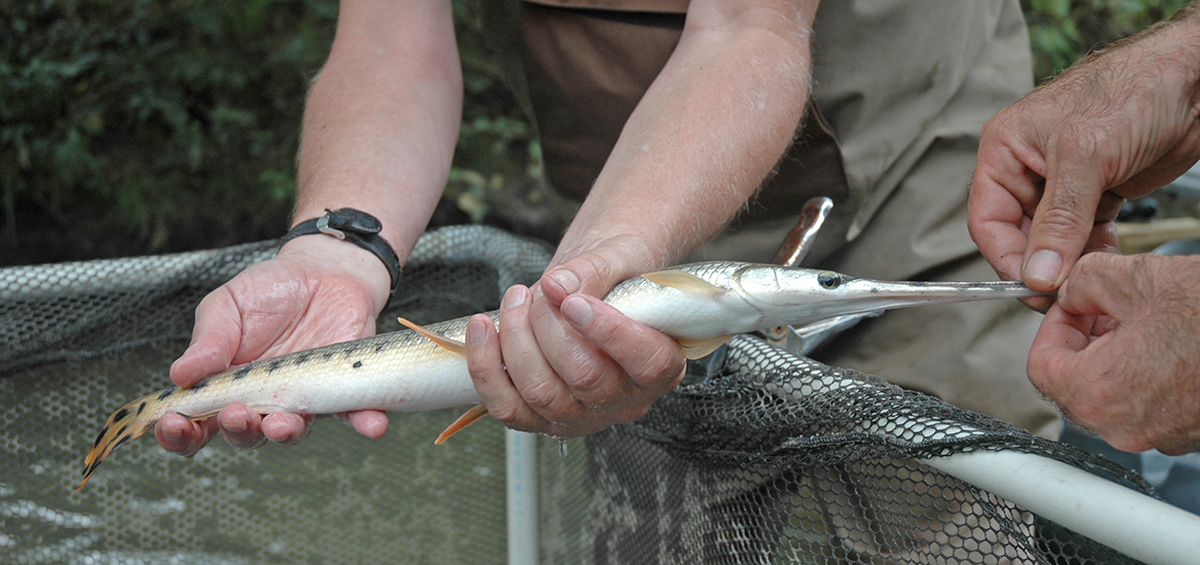
Another interaction, which was quite shocking, and then funny, came on a seining program at Big Darby Creek. Mac Albin had a very large seine net and myself, as volunteer, and a group of families on the program, were walking in the stream to drive fish and aquatic animals toward the net. A longnose gar was in the channel being driven towards the net, but it was having none of it! These ancient fish have a very long and slim snout, about three times the length of its head. This ‘nose’ can easily reach up to a foot in length. This particular gar was about 14 inches long, including the nose. It turned away from the net and swam full tilt in the opposite direction—and went up the shorts of one of the 12-year-old kids driving toward the net. The gar was up his shorts and out again as quick as a flash. The kid was definitely surprised. I bet the gar was also. They both recovered quickly. Holding onto a longnose gar is like trying to hold on to a wiggling greased hot dog. We then looked at what we netted.
My third memorable interaction happened on another Mac Albin program. It was an evening hike and campfire program. And even though it was in October, it had been a beautiful 70 degree day and we still had perfect skies in the evening. The fine weather brought out a large crowd of about 120 people, which I think was a record for that type of program that late in the year. We were in what was previously a Girl Scout Camp, off Gardiner Road. With so many people, that all started out as one group, the crowd naturally separated into different groups as people walk at different paces. Mac led the group, a volunteer stayed at the end, while volunteer Sue Chenowith and I were in the middle. About three-quarters of the way through there was a large gap in the groups. Sue and I were the lucky group, because a barred owl showed up and sang to us. We were all absolutely enchanted by it. When we met up at the campfire and told the other group what we had experienced, they were so disappointed to have missed the magic.
Traveling – places I’ve been, places I’d love to go
Karen and I love to travel. Every winter, for the past four years, we’ve spent a couple of weeks on vacation in Maui, Hawaii. The first year we went in March, but in the past three years we went in January. We like to get away from the Ohio cold for a while. Temperatures are round about 70 degrees at Maui in January and I can wear shorts the entire time. Whales are off the coast that time of year with new calves and we like to sail out on catamarans to get close-up looks at these magnificent creatures. We also like to go hiking there and do some snorkeling.
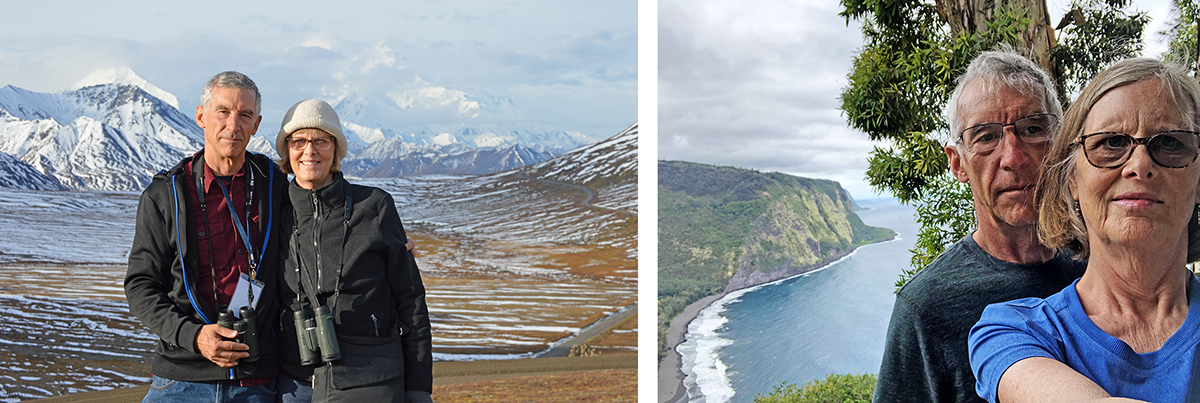
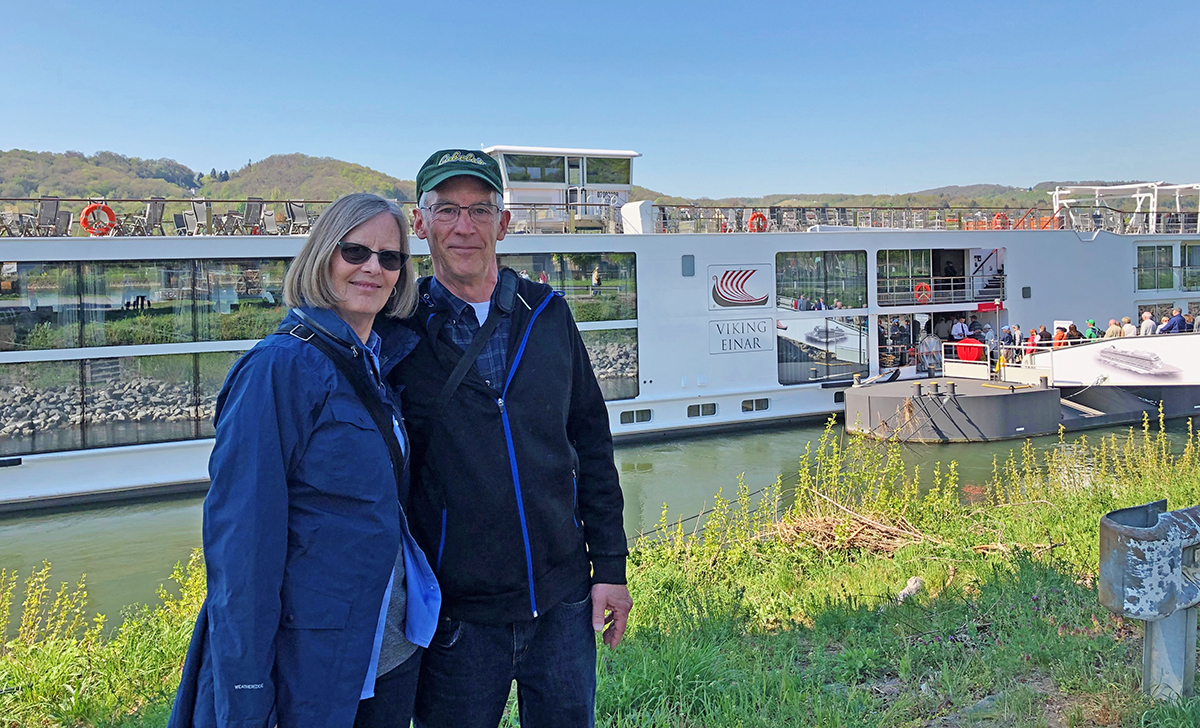
We also love going on cruises. Twice we’ve been to Europe on the Viking River Cruises you see advertised here so much. We went on the Amsterdam to Basel cruise, which is an eight-day cruise along the Rhine. Then we flew to our daughter’s house near Munich before returning home. Later we did a cruise from Passau to Budapest on the Danube. Then visited our daughter again. What we love about the Viking Cruises is the attention and luxury personal service you receive. There are only about 190 passengers on the ships, which allows for that personal touch you never get on the larger cruise ships to the Caribbean and Alaska. Not that this has stopped us from really enjoying cruises to those destinations too. There are about 1,500 passengers on these cruise ships, so the service isn’t quite as personal, but you still get all your food provided, and there is great entertainment and shows on board every night.
Fun facts about me and my family
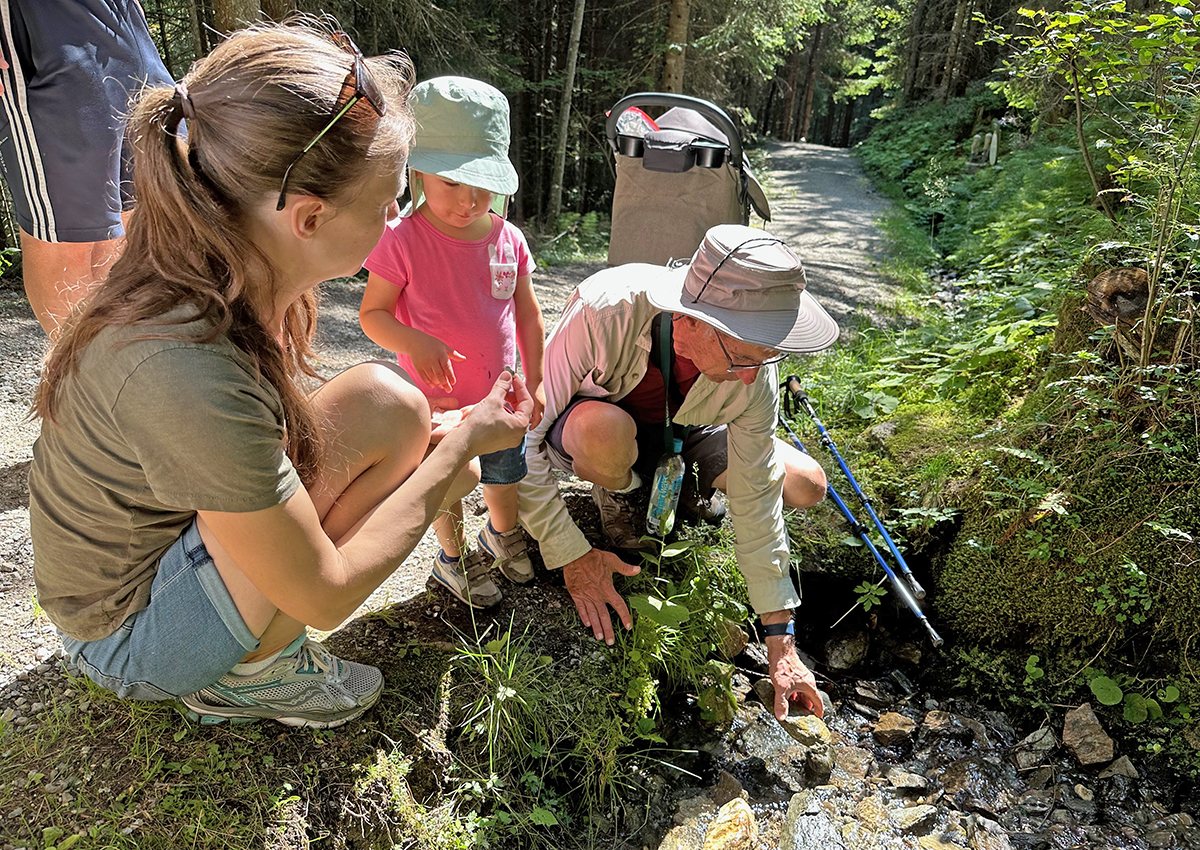
1. Ich wohne in Deutschland, Papa! Our daughter, Amanda, lives in Germany near Munich, and we just returned from visiting her. As early as seventh grade, she had developed an interest in the German language. She went to OSU for a degree in Engineering and also earned a minor in German. The university was interested in having her join the staff to teach, but she wanted to go to Germany and take a masters degree there. She earned a masters degree from a German university and landed a job in Dresden. Just before leaving Moosburg to start the job, she met a German boy. She had a long distance relationship during her two and a half-year year contract. She moved back to Moosburg and married Kuabe in 1995. They now have two children (Jonas and Teresa) and are coming to visit us on June 23 for about four weeks. We are going to take them to Myrtle Beach for a week’s “vacation.” Our eldest son, Mark, will be coming with us, along with his wife and family, 12-year-old twins, Blaise and Charlotte, and 10-year-old Reid.
2. Our son is the family’s real computer genius! I may have had a full career founded on my knowledge and aptitude with computers and computer networks, but it’s our younger son, Jason, who is the real computer genius in the family. Jason never continued his formal education beyond high school, but he’s a natural with computers. He worked for OM Scotts on world-wide network security, blending international companies and their systems to fit with Scotts’ home-based network.
Then he was recruited to work with Mondelez, the world’s largest biscuit manufacturer, who makes Oreos and many other internationally known brands. Their IT department is actually based in Greece, although Jason worked mostly from here in the States. When the company insisted that all their IT staff had to relocate to Greece, he chose not to relocate. He is now employed by a large property management firm, still working from home in Raymond, Ohio, a small town of about 420 people in Union County, about 10 minutes north of Marysville.
Our oldest son Mark is married to Nicole and has three children. Mark has a Welding Engineering Degree from OSU, but like me is not working in the field he went to school for. He taught himself to write code and landed a job with Columbus based Cover My Meds, when they were a small company. Several years after CMM was purchased by McKesson, Mark was recruited by one of the founders of CMM to work for his new startup, AndHealth. Mark and family just moved into a new house between Delaware and Alum Reservoir. Nicole is a High School Teacher in the Jonathan Alder district.
My three children share my love of nature and equally love to cook and bake, and create stuff.
3. My garden sanctuary!
I have a big garden and I love working in it. I grow lettuce, zucchini, potatoes, kale, green and Lima beans, butternut squash, green peppers, raspberries, rhubarb, herbs, and others as well as some prairie flowers, like royal catchfly.
I provided a habitat for a tiger salamander, who I named Gollum, as he reminded me of the character in the Hobbit. He was with me for 10 years and he visited a few Metro Parks programs with me over the years, and helped teach kids about salamanders. I’ve also raised spotted salamanders from eggs, and tree frogs from tadpoles. I currently raise mason bees in my garden, as they become great pollinators of my cherry tree. Mason bees are a hundred times more prolific as pollinators than honeybees, and they don’t sting, as they have no queen to protect. Unfortunately their life as an adult is just in May.
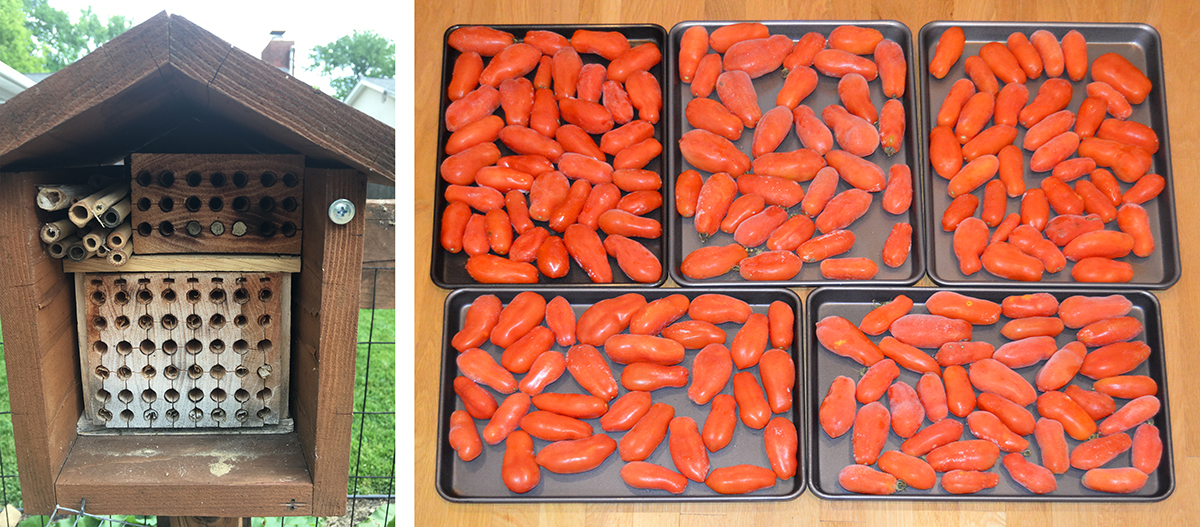
I use 6-inch-long paper tubes as the breeding sites for the bees. A bee will collect pollen for the tube, lay an egg with the pollen, then seal that part of the tube with mud, then continue adding pollen, eggs and mud until the tube is full. The last two spaces in the tubes are used for male eggs. There could be over eight chambers in each five-sixteenths of an inch diameter tube. The males will emerge from the tubes in spring and wait for the females to emerge. Usually in November, when the bees are in the pupa stage, I remove the pupal case from the tubes and clean off the cases, and “candle” the cases, which helps to stop parasitic wasps and mites from taking over pupas and the next generation of bees. I then store the pupal cases in a fridge, or a cold spot in my basement, which keeps the pupas from hatching until I put the pupas outside again in late March.
My favorite food and dessert
Both Karen and I love to cook. I especially like to bake. I make a lot of cookies and bread, including my own sandwich buns, made with whole wheat flour and no preservatives. I put them in the freezer and take them out as I need them. One of my favorite loaves is an Italian rustic bread, from a recipe in Cooks Illustrated. I also subscribe to a few online recipe apps. I enjoy making several breads that use a sourdough starter, which I have been growing in my fridge for over two years, as the pre-ferment for the dough. As for a favorite meal, I love pasta dishes in general, and Karen’s homemade lasagna in particular. Other favorite meals we share are cheesy grits with shrimp, and stuffed peppers with ground beef, rice, beans and spices. We have an Instant Pot that we use a lot. It’s a pressure cooker and we have tons of recipes in a book called The Instant Pot Bible. Our favorite recipe in there is for cheeseburger soup.
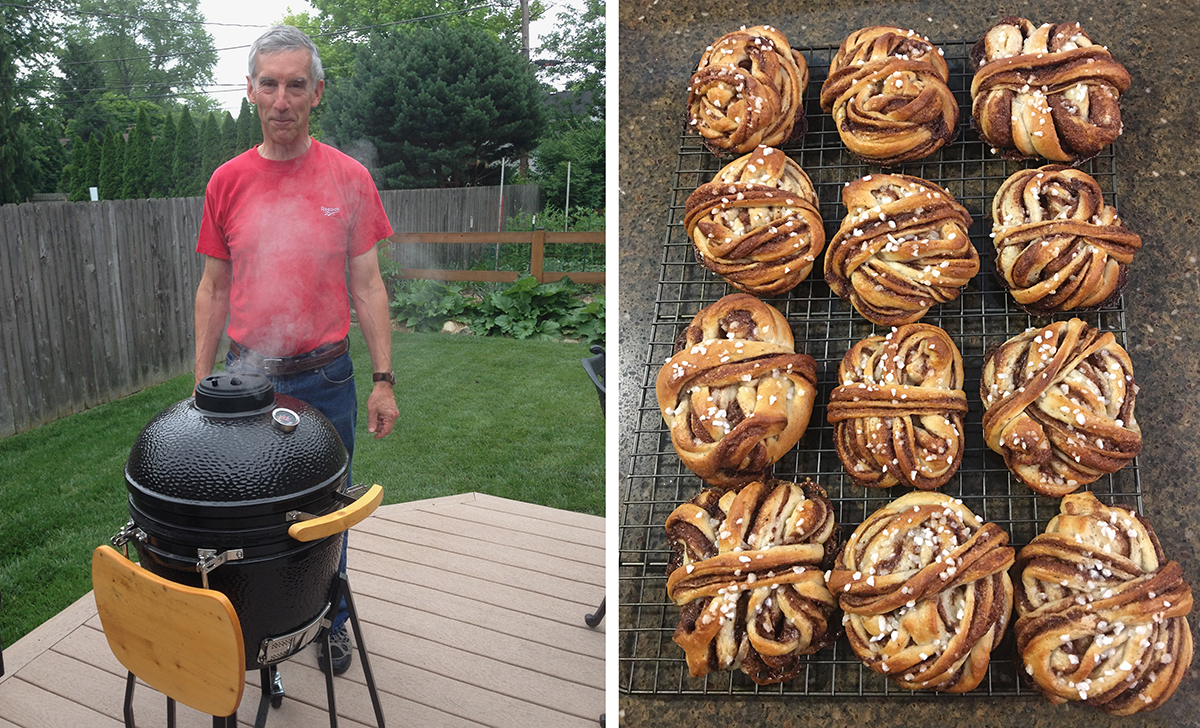
My favorite dessert is something I bake myself, chewy brownie cookies. I got the recipe from the New York Times Cooking section. Sometimes I change up the recipe a little by adding peppermint. Also, like my wife, I have never been known to turn down ice cream. Kroger’s own brand is surprisingly good. They have a chocolate truffle ice cream that I really like.
My favorite entertainment
Karen and I like to watch TV after dinner. We probably watch too much TV, but there are some good shows that we really enjoy. Many of them are on PBS, although a current favorite show, “Will Trent,” is on ABC. The title character is a special agent with the Georgia Bureau of Investigation. He grew up in the orphan and foster care system and has dyslexia, but he sees things and makes connections that other investigators just don’t get, resulting in him solving more cases than any other investigator. We DVR and enjoy watching “Late Night with Stephen Colbert.”
I love doing the puzzles in the New York Times, especially Strands and Wordle. I was on a 217-day win streak with Wordle until just this week, when the simple word EAGER tripped me up. Karen enjoys watching OSU football games. I often watch a game with her, but sometimes one of my many projects takes priority.
What Battelle Darby Creek Naturalist Debbie Ruppersburg says about John
“John Lorenz is an incredibly dedicated volunteer who brings a true passion to all things insect-related at Metro Parks. His enthusiasm is infectious as he immerses himself in the world of six-legged creatures, from macroinvertebrates to Monarch butterflies and even assisting with raising crickets as food stock for our educational animals. He’s a fantastic resource and a real asset to our team.”
For John’s SQM Tray layouts, go to: https://1001crickets.wixsite.com/production/aquatic-macro-invertebrates
For how to raise crickets John’s way: https://1001crickets.wixsite.com/production
Thanks for sharing John. I just looked up the recipes for Kanelbullar and Chewy Brownie Cookies and plan to bake both this summer. Thanks, John
John, I’m hoping to do more volunteering with the Metro Parks now that I’m retired from teaching, but I always appreciated your friendly expertise when my son, Noah, and I had the opportunity to learn from you during volunteer events. Great to hear more of your story!