
GORDON MITCHELL
Land Management Coordinator
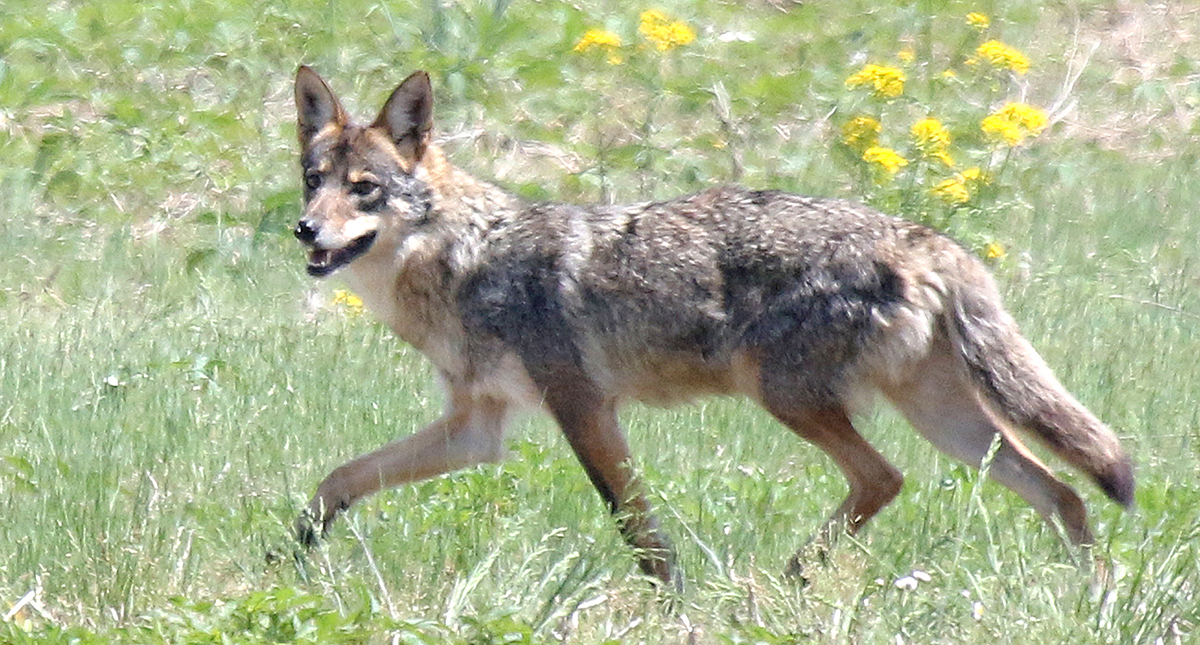
Coyotes are relatives of the gray wolf, which has long been extirpated from Ohio. The scientific name for coyotes, Canis latrans, is Latin for “barking dog.” The generic name, Canis, is “dog” and its specific epithet, latrans, is “barking or barker.” The common name, Coyote, is from the Mexican Aztec Indian word, coyotl. Other common names for this animal are American jackal, brush wolf, little wolf, and prairie wolf.
Coyotes are the smallest wild Canis in America. The eastern coyote subspecies may be larger than the western species. From head to tail, they range from 39 inches to 53 inches in length. With the tail itself generally between 11 inches and 16 inches. They can weigh up to 60 pounds, although their average range is between 15 and 45 pounds. Their color varies. Dorsal colors (top and back) can be grizzled gray to brown, orange or reddish-gray, or yellow-gray. Their dorsal hairs may be tipped in black. The abdomen and throat are white. Legs, feet and ears all have a rusty, rufous color. Their lower forelegs are light with dark vertical lines, and their tails have a black stripe on top and have a black tail tip. Their face is gray above and has a reddish muzzle.
Coyotes have thick fur, which makes them look heavier than they are. The fur is coarse, dense and long, and thickest during winter. They molt in spring or early summer.
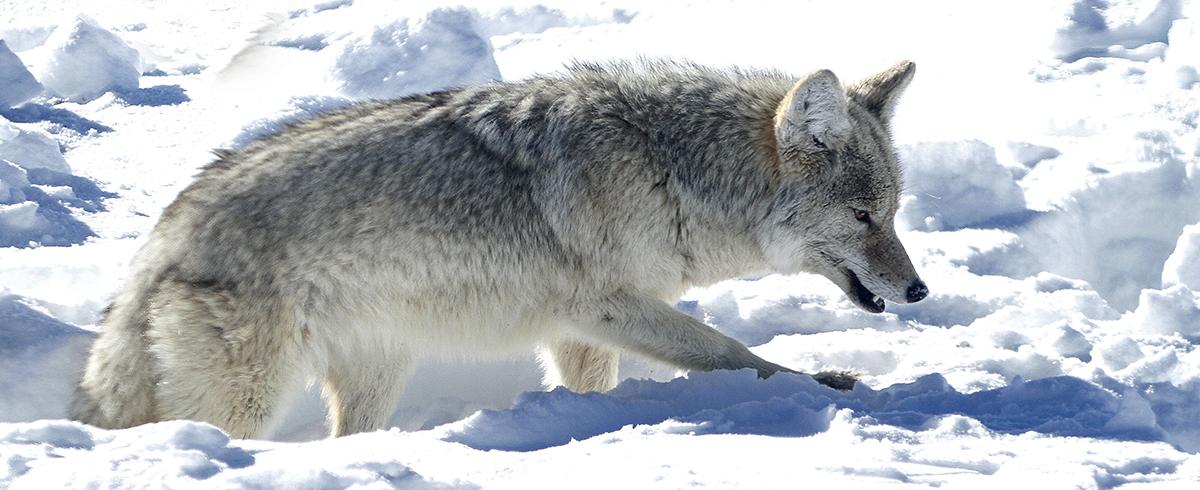
Coyotes are highly intelligent, resourceful and adaptable animals, and live comfortably in a variety of habitats. These habitats include deserts, plains, prairies, grasslands, brushy areas, open forests, thickets, woods’ edges, agricultural areas, and suburbs. They prefer areas of mixed habitats and usually avoid large, dense, unbroken forests. They are now common in Ohio and have been seen in all the Metro Parks, although they are but a recently arrived species in our state. Their original range covered the Plains States, but today their range extends from southern and eastern Alaska, through western and southern Canada, throughout the entire United States, and down into Central America.
Their range extended eastward when settlers arrived and cut down forests. And when farmers and ranchers moved westward, coyotes followed them, hunting the ranchers’ livestock.
COYOTE NESTING BURROWS
Unlike other mammal species, coyotes do not use permanent burrows. But they do use burrows as maternal dens. These nesting burrows can e found on mounds, riverbanks, slopes, or in gullies. The entrance to these burrows is about 20 inches high and about 10 inches wide. This entrance may have an adjacent small mound or a fan of soil. The burrow tunnels are about 1 to 2 feet in diameter and extend from 5 to 30 feet in length. There may be more than one tunnel within a single burrow. Most of these tunnels end with a large nesting chamber. Sometimes two to three females may share a single nesting den.
The females usually excavate these nesting burrows from scratch or enlarge an abandoned burrow that was excavated by another animal. Instead of excavating burrows, some coyotes will use small caves, crevices, culverts, hollowed logs, rocky ledges, or deserted buildings for their maternal dens.
COYOTE REPRODUCTION
Coyotes usually breed once a year, mainly from January to March. Coyotes are often paired for several years. If their population is low, they may pair for life. During breeding season, the females go into estrus for about two to five days. During that same season, the males enter a period of spermatogenesis, when they can produce spermatozoa. Before mating, the pairs may howl in duets.
After a gestation period of about 58 to 65 days, the female gives birth to her litter, which may be as high as 19 pups. These pups are usually born within the maternal dens. They are born blind and helpless, and have short, brown-gray, and woolly fur. The newborn pups may weigh about 9-10 ounces. These pups are tended by both parents and even by older siblings.
The pups grow rapidly. They may gain about 10 ounces per week until they are weaned. In eight to 14 days, their eyes are open. In three weeks they may leave the den for short periods. In five to nine weeks they are weaned. At two months they are learning to hunt. By six to nine months the pups disperse from their maternal dens to seek new territories. Unfortunately, less than 20% of the pups survive their first year. When seeking their new territories, a coyote may travel as far as 100 miles. The males usually travel farther than the females. After nine months, the coyote is fully grown. The females can breed in one to two years. The males can breed in two years.
COYOTE TERRITORIES
Coyotes set up their own territories, which may have a radius of 1.5 to 15 miles. During summer, their territories are usually larger. They mark their territories with their own excretions or with their own scent gland secretions. The females’ territories are usually smaller than the males. There are usually only one or two coyotes per square mile. An individual coyote or a pair of coyotes do not readily defend their territory. However, a coyote group will defend its territory.
They are primarily a nocturnal creature, active at both dusk and dawn. They mostly sleep during the day. If there is no nearby human activity, they will sleep in open areas. If there is any nearby human activity, they will sleep in densely vegetated areas. In the west, Coyotes may be more active during the day. Much of their daytime activities depend upon the presence of any prey and upon the presence of any human interference. Eastern coyotes may also come out during the day, in the summer.
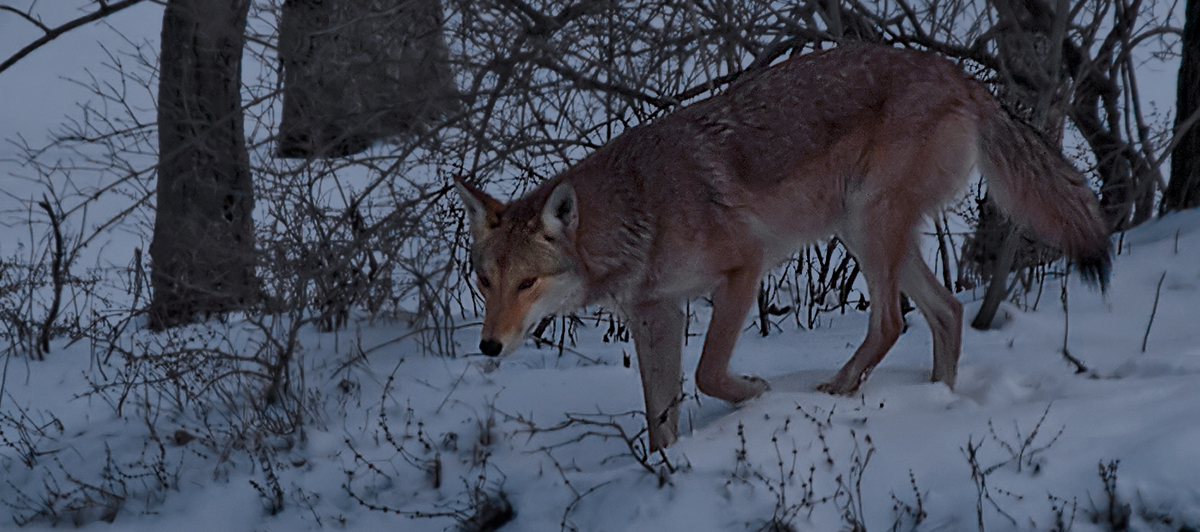
This animal travels constantly. When it travels, it usually follows old trails or walks on ridge tops. Their main methods of locomotion are walking, trotting and bounding. They can maintain some of these fast paces for several hours. They can trot at 5-6 mph and can gallop at 25-30 mph. For short distances, coyotes can run up to 45 mph. It can also leap up to 14 feet. Coyotes are also good swimmers and will swim up to half a mile. This species is the fastest member of the Canidae family.
COYOTES AS HUNTERS
Coyotes are primarily solitary and usually hunt alone. With small animals, coyotes usually stalk, freeze, and then pounce upon their prey. Their hunting route can vary from 10 to 400 miles. Sometimes, they may hunt along with other coyotes, such as in pairs or in small groups (bands, packs, or routs). Older males usually dominate these groups.
A small group may have about three to eight coyotes, and usually consists of a mated pair and some of their variously aged offspring. Larger group may include several non-breeding individuals, but these larger groups can be unstable.
A group sometimes hunts in relays, especially if their prey is fast. In relays, coyotes usually chase their prey in circles. A group may hunt with one or more coyotes initially chasing their prey. The rest of the group waits to ambush their prey when it approaches them. A group may even attack a larger animal, such as an adult white-tailed deer. They are careful to attack a deer that is old, sick, injured, or is slowed down in deep snow.
Coyotes will sometimes hunt with other species, such as badgers. While the badger is digging out its prey from the prey’s burrow, a nearby coyote will chase any prey that escapes from another exit. Although a coyote will share its kill with other members of its own group, it will not share its kill with the badger.
Coyotes are both an omnivorous and an opportunistic feeder. They will eat almost anything edible. They will bury and will mark any uneaten food. About 90% of its diet consists of animals. Most of these are small animals, such as small mammals, reptiles and amphibians, fish, ground-nesting birds, eggs, and numerous invertebrate species. They also feed upon carrion. Coyotes also prey upon livestock, such as poultry, calves, lambs and piglets. They will also attack small dogs and cats. The remaining 10% of a coyote’s diet consists of plants, including berries, fruits and mast. Coyotes often raid gardens and croplands.
COYOTE VOCALIZATION
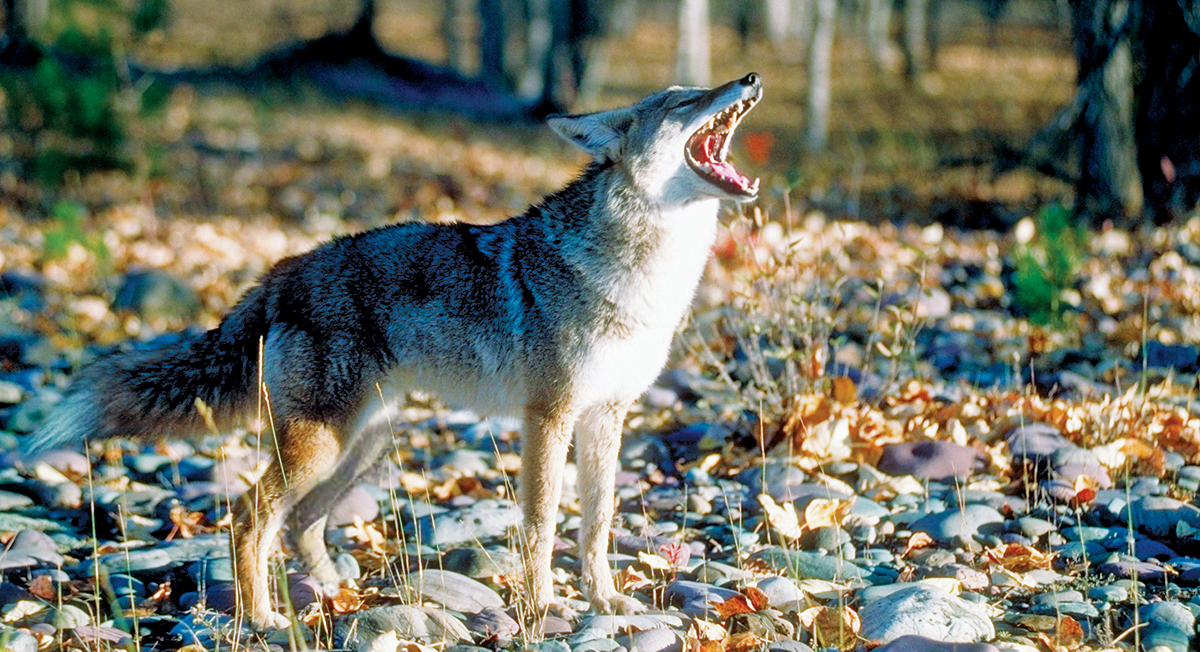
Coyotes are best known for their calling, which is usually done at night. Their long-range calls consist of a few short high yips, followed by long howls, then followed by some short yaps. Their short-range calls consist of barks, growls, squalls, whimpers and whines. Coyotes use these calls as a form of communication. They may call individually or in groups. They mainly use these calls to give their locations, to mark their territories, and to strengthen social bonds.
very cool thanks!