
TIFFANY GUO
Guest Blogger
When I was a seasonal naturalist over this past summer at Glacier Ridge, I followed Catie, the senior naturalist, as we guided visitors along the wooded Red Oak Trail. We spent those June and July evenings leading our visitors in scouting red-tailed hawks and identifying the papery moths that sought the beam of our flashlights. Before we embarked with a hiking group, Catie would turn to pose the question: what animals do you expect to come across today? Our hikers would shout out a diversity of answers, including everything from small amphibians to large mammals.
Occasionally, we’d get “bears!” This answer was always appreciated because it allowed us to segue into a (not so) fun fact: wild bears are practically never seen in Ohio. I wish we could say this is because they’re shy around humans, like the eastern garter snake, or elusive under daylight like the flying squirrels up in the canopy. The real reason, though, is rooted in Ohio’s postcolonial past.
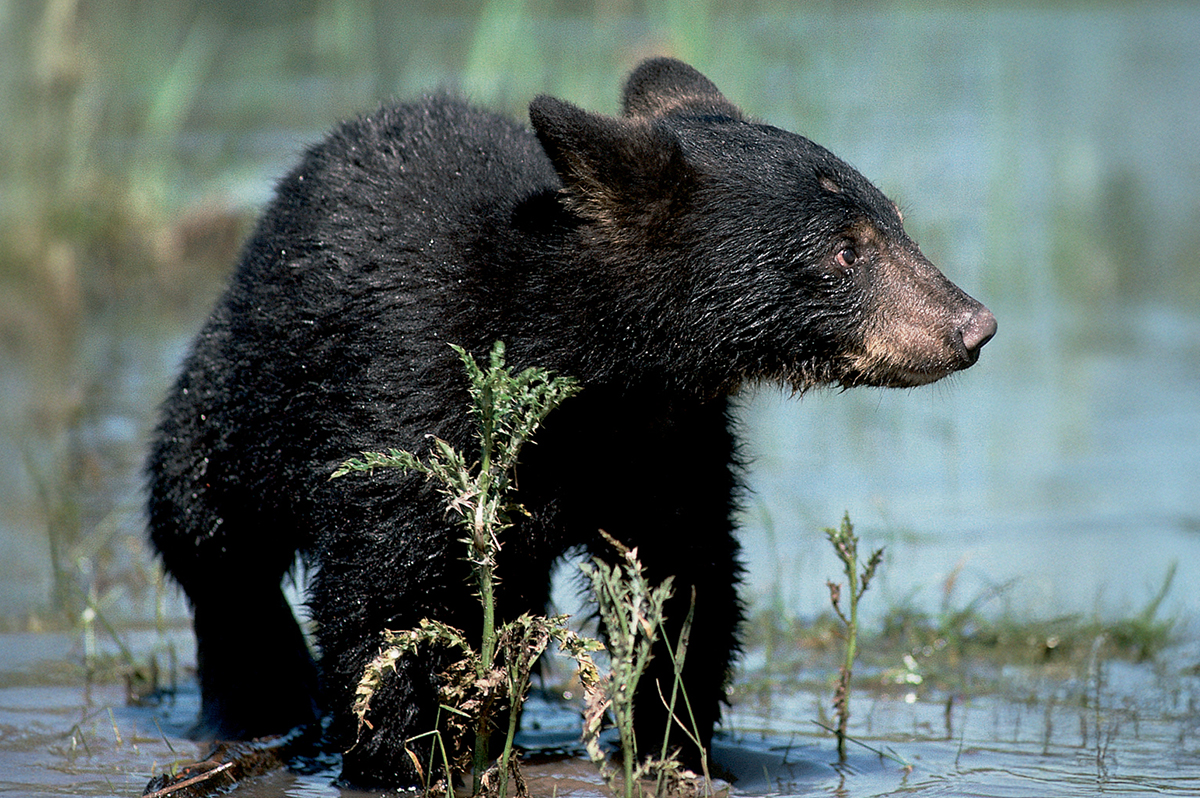
The American black bear, Ursus americanus, is native to the state and used to be encountered regularly before the early 1800s, as European settlers arrived. Even still, it remains the most common bear in Ohio, but only because it’s the only bear in Ohio. Less than 100 individual black bears are estimated to roam the state as of today. Compare this to the white-tailed deer, estimated by the Ohio Division of Natural Resources (ODNR) at a population of up to 900,000, or the less-abundant eastern coyote, estimated at 50,000. Black bears, in comparison, are all but nonexistent.
The American black bear was killed, driven out, or otherwise eradicated from Ohio in the 19th century mainly due to deforestation and ensuing habitat loss after the state was colonized. As a species that reproduces slowly relative to other mammals, the remaining black bears dwindled especially quickly under unregulated hunting and trapping by farmers. Many were removed in a bid for territory as farmers laid claims to land under a thriving agricultural industry. Nicknamed the “bread basket” of the nation, Ohio became a leading producer of corn, wheat, and other grains during this time. As agriculture became the literal bread and butter of the state, farmers continued to trap black bears to minimize losses on their produce. It took only until the year 1850, less than a century after colonization, for ODNR to report the black bear population at a cold, hard zero.
Today, a gradually-growing population resides in the heavily-forested areas of northeast and southeast Ohio, a rare few making their way to central Ohio. In fact, a black bear was caught on a homeowner’s security footage in Obetz, near our own Three Creeks Metro Park, back in 2023, as reported by the Columbus Dispatch, and another was photographed at Clear Creek Metro Park the year before. These were the only sightings in all of central Ohio since 2004. Meanwhile, the population has continued to slowly replenish in the last few decades, partly due to restoration of forests and black bears wandering across borders from neighboring states including West Virginia and Kentucky. Both of these state have been graced with growing black bear numbers since the late 20th century, as per the West Virginia Department of Natural Resources and the US Kentucky Fish and Wildlife Department.
At Metro Parks, the naturalists all work closely with the surrounding wildlife. During this past summer, I gradually expanded my knowledge of what we might come across on our hiking programs. In both Glacier Ridge and our other parks, the wealth of species in each location seems to capture a world of its own. I knew Glacier Ridge, for example, by our white-tailed deer and the monarchs that perused the paved trail we called Butterfly Alley. Through my adventures at the Battelle Darby Creek Nature Center, I began to anticipate meeting the longnose gar on exhibit from Big Darby Creek, and the herds of bison that would, if I got lucky, appear in the plains. In all the diversity, though, I knew that I’d never spot a bear like I might in our surrounding states. Central Ohio is plainly not the destination to scope out a black bear in the distance, dipping its head in want of brook trout or hollowing a den underneath a fallen trunk.
Still, I like to think that in my lifetime this will change. Even now, even in an area as unlikely as central Ohio, there may be black bears right under my nose, returning to the Midwest underbrush, already reclaiming their land as we speak.
there are black bear below noe bixby road off main street in the woods by the creek down the large hill.
You are right, it looks like at least one was spotted there back in October! Hope it’s enjoying itself