
ELAINE HALL
Assistant Resource Manager
Each year, Metro Parks conducts a variety of biotic surveys throughout the district. You may catch a glimpse of staff and volunteers already out in the field just before the sun comes up in May and June for Breeding Bird Surveys or even a group of us gathering and heading out into the woods on a hot, muggy, mosquito-filled night to survey bats.
Our biotic surveys provide important information about the health of our ecosystems and their progress as they mature from restored landscapes. The presence or absence of certain species helps guide us and set goals on what kind of resource management is required for a particular field, wetland, or woodlot. Analyzing the data from these surveys reveals some interesting information, including the discovery of a newly recorded species living in our parks.
We also monitor our aquatic resources through various surveys studying fish, mussels, and macroinvertebrates. There are also other monitoring programs in the district, such as chorusing frogs, vernal pools, and bluebird boxes. The three major biotic surveys that resource management coordinates every year include Breeding Bird Surveys, Bat Roost Monitoring, and Butterfly Surveys. Data collected from these surveys are submitted to larger bodies of research monitored by agencies such as the US Fish and Wildlife Service (USFWS), US Geological Survey, and the Ohio Department of Natural Resources (ODNR).
Breeding Bird Surveys
Approximately 180 species breed in Ohio every year, and including historical nesters, 212 species have been documented as breeding in the state. This year, Metro Parks completed 27 breeding bird survey transects, yielding a whopping 127 of these species, and surveyors heard or saw over 5,000 birds! Three species were brand new to the districts’ breeding bird survey – Bank Swallow, Herring Gull, and White-throated Sparrow.
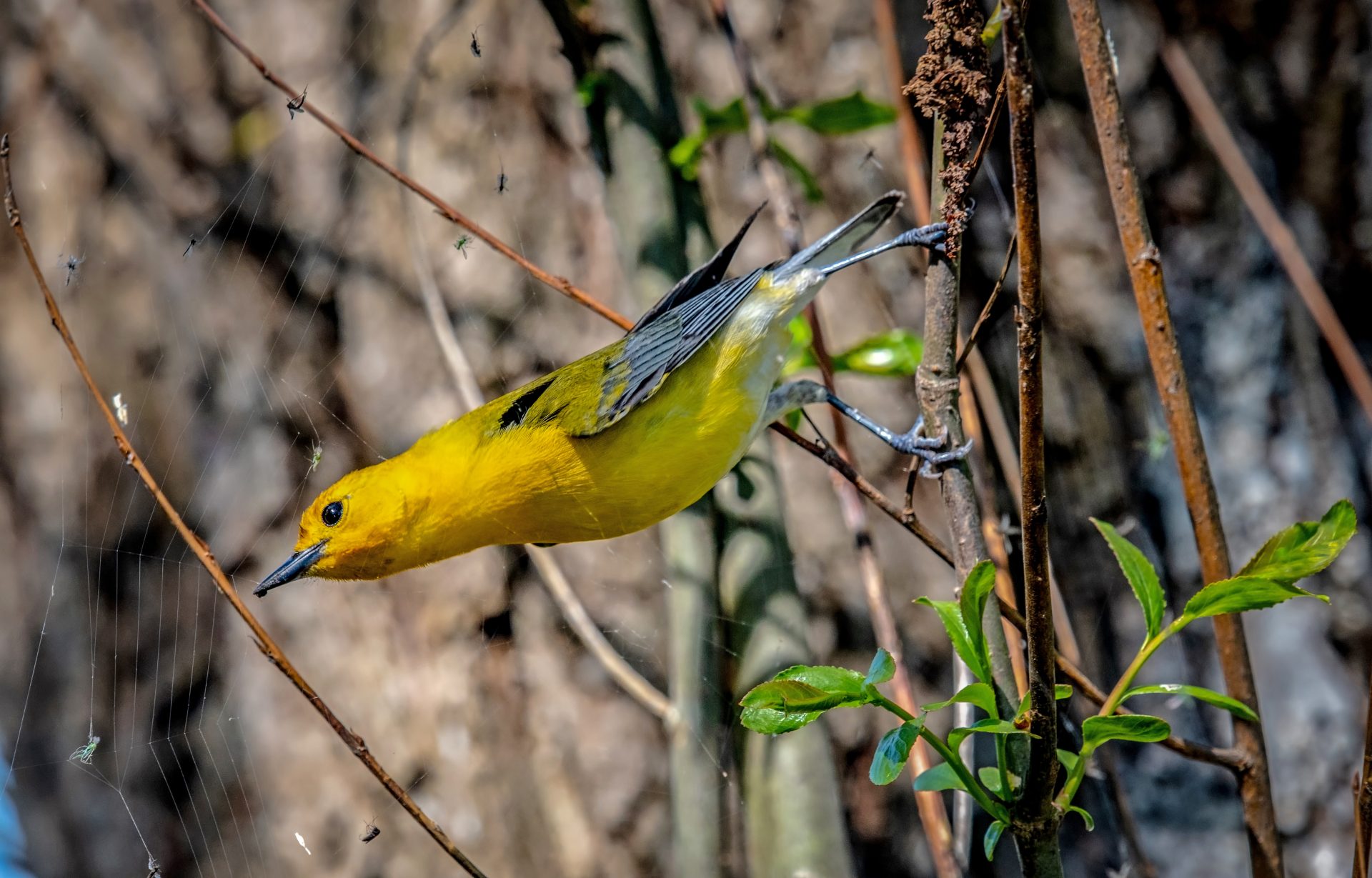
During this year’s surveys, Scioto Grove Metro Park proved to have some of the greatest numbers in terms of bird diversity and abundance. An outstanding 53 species were recorded. In only its 5th year, staff and volunteers recorded 7 new species, 4 that are of conservation interest, including the Bald Eagle and Prothonotary Warbler, an Ohio species of concern! Prothonotary Warblers are special for being the only eastern warbler to nest in tree cavities, often near water, where they forage low in the canopy. They are secondary cavity nesters, using old woodpecker holes or natural cavities, and require flooded forests or wetlands, making them indicators of healthy swamp ecosystems.
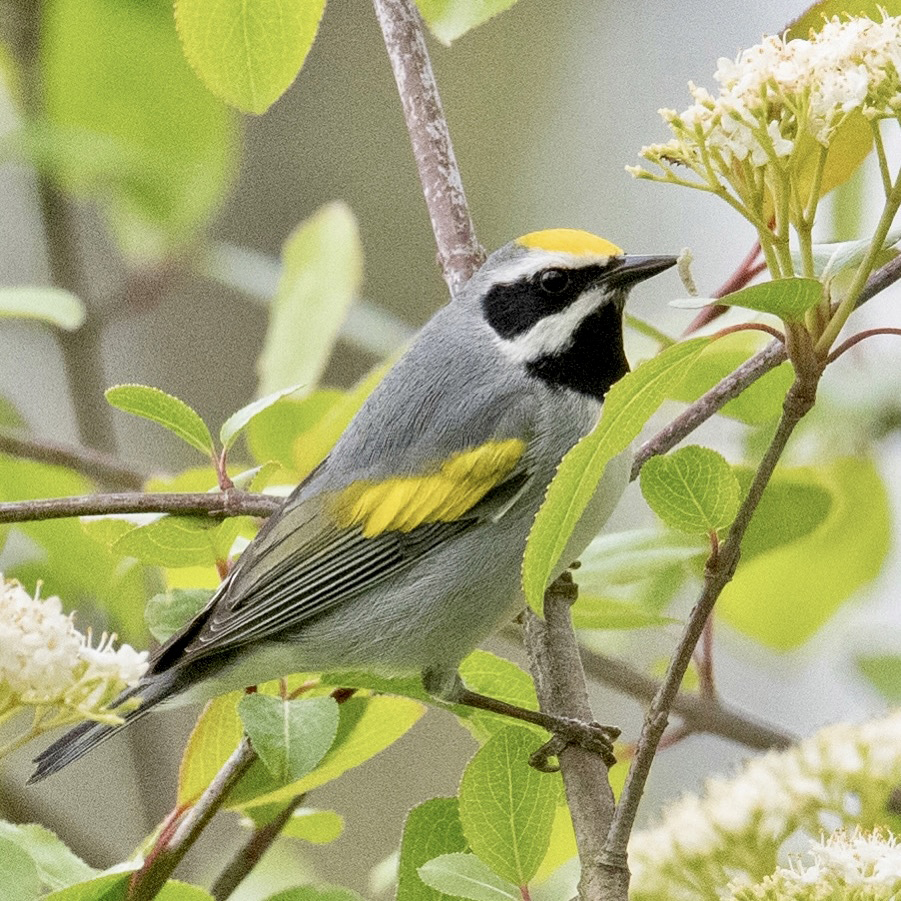
Being the largest state nature preserve in the state of Ohio, and a completely different ecosystem than the rest of Central Ohio, Clear Creek Metro Park houses breeding birds that are distinct comparatively, and of high conservation sensitivity as well as high diversity. Most notably, for the first time since 1985, surveyors recorded a Golden-winged warbler, Vermivora chrysoptera, during the survey. In order for a bird to count toward the record and be documented in the surveys’ data, at least two human surveyors have to agree that they are hearing and or seeing said bird. Golden-winged Warblers are exceedingly tricky to identify because Blue-winged Warblers and Golden-winged Warblers can sing each other’s song, and the species will often hybridize. Blue-winged Warblers conservation status is much less than that of the Golden-winged Warbler which which is a state species of special interest, Bird of Conservation Concern (BCC) by the USFWS, and listed as Near Threatened by the International Union for Conservation of Nature (IUCN) Red List. In fact, Golden-winged Warblers currently have a petition under review to be added to the Endangered and Threatened Species list. Early successional habitat loss needed for nesting, wintering habitat loss in Central and South America, and hybridization with Blue-winged Warblers have all led to the species decline.
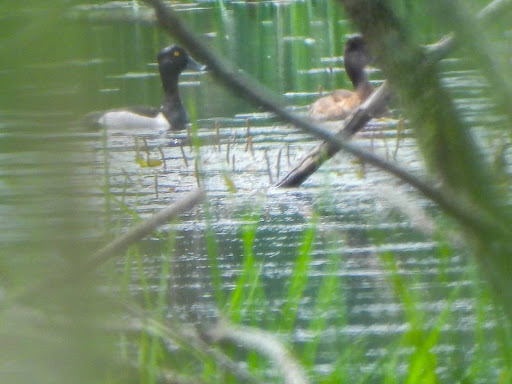
Oftentimes, our most exciting biotic records are not even during official surveys, and are reported to us by visitors and volunteers, like you! This year, we received a report from a volunteer of a pair of ring-necked ducks they spotted out monitoring their wood duck boxes in June at Prairie Oaks Metro Park. The timing of the sighted pair would suggest that they would be nesting somewhere in the area. As we attempted to monitor the pair, we were unable to relocate the pair or sign of any offspring. Had they stuck around, it would have likely been the first breeding record for ring-necked ducks in the state of Ohio, with the next closest records being in Saginaw, Michigan!
Butterfly Surveys
Metro Parks now monitors 11 butterfly transects across the district. With the onboarding of a new transect at Scioto Audubon Metro Park! Documenting 15 Lepidoptera for the park’s biotic list.
On December 12th, 2024, the monarch butterfly was proposed to be federally listed, but the comment period was reopened in March of 2025. The monarch butterfly was not included in the September 2025 publication of the current administration’s “Unified Agenda,” which lists executive agency actions that are expected to happen within the next federal fiscal year that started October 1, 2025. That means a final decision is at least another 9 months away, and on the species’ account and ruling page with USFWS, its Agenda Stage of Rulemaking is now listed as “long-term actions,” which means “not expected to result in either additional regulatory actions over the subsequent 12 months or after a specified month and year.”
According to the US Fish and Wildlife Service, results of the most recent monarch Species Status Assessment revealed that by 2080, the probability of extinction for eastern monarchs ranges from 56 to 74%, and the probability of extinction for western monarchs being greater than 95%.
This year’s butterfly survey revealed an uptick in monarch butterflies. Optimistically, we saw an increase in their numbers, and many could even visually sense this change.
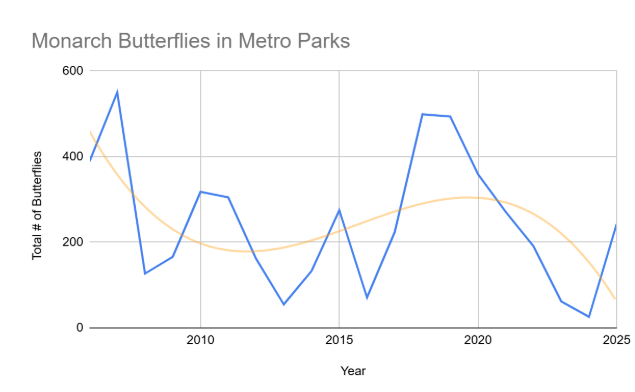
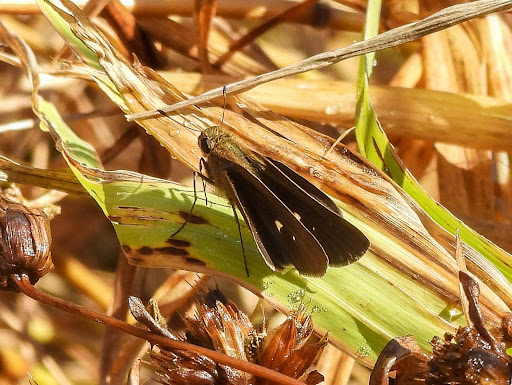
Many factors could influence the butterfly’s boom and bust years, such as weather. Several other species that can be observed in Ohio are also affected by the weather and visit Ohio from the south during the right conditions. Their caterpillars cannot survive the winters here, but they also don’t migrate like monarchs. They wander north with warmer and dryer summer seasons. American Snout and Ocola Skippers in particular have only been documented on our butterfly surveys at Highbanks in 2019. However, they have been documented at Inniswood, Glacier Ridge, Blendon Woods, and Battelle Darby Creek as of 2025 from other findings.
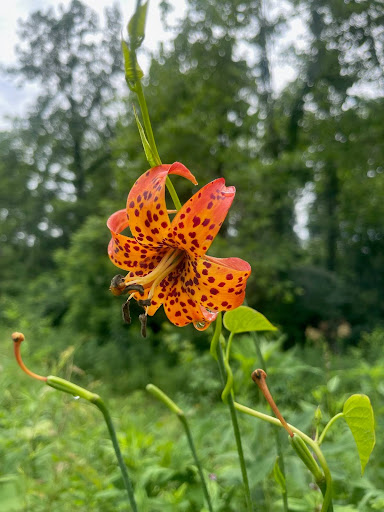
Other significant flora and fauna finds from 2025 include a discovery of Michigan Lily, Lilum michiganense, near a recently restored site in the park district.
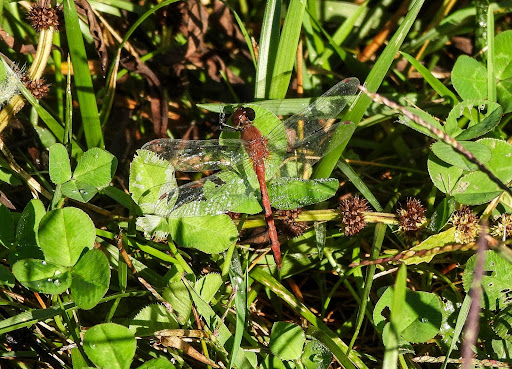
Lastly, a district record. Being documented for the first time in Metro Parks is a White-faced Meadowhawk, Sympetrum obtrusum. A dragonfly that is uncommon, but when found is often locally abundant. The Meadowhawks, genus Sympetrum, number 13 species in the United States. Of these, eight species have been found in Ohio. All are small red dragonflies, and can be hard to distinguish.
Thank you for your work and commitment to the parks and healthy ecosystems.