
GORDON MITCHELL
Land Management Coordinator
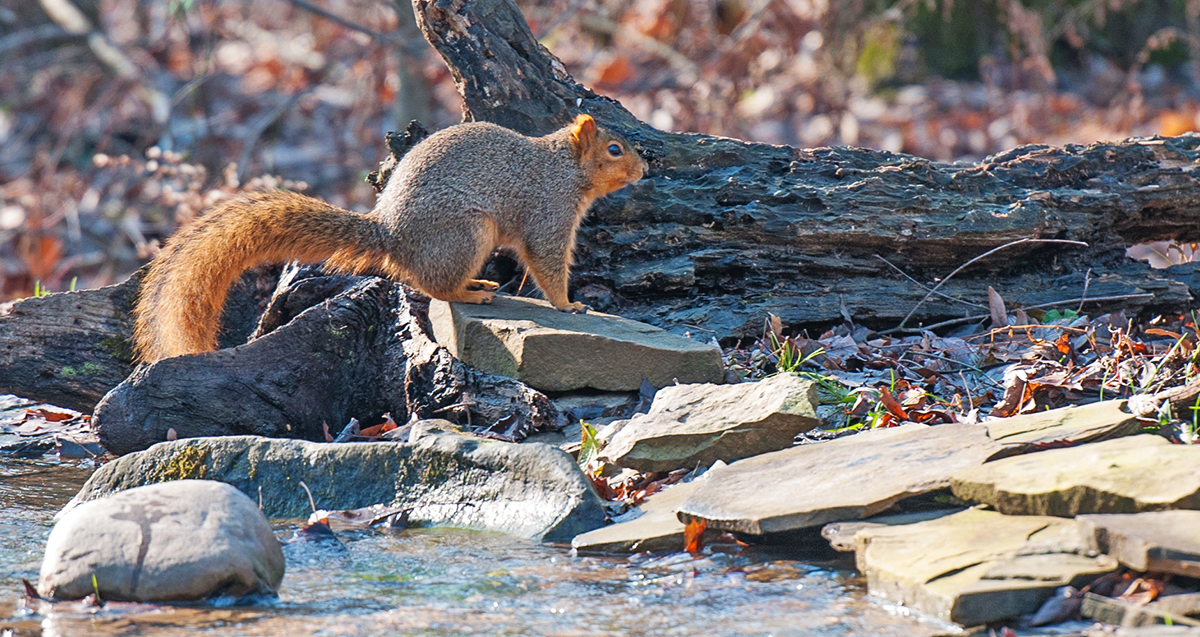
Fox squirrels are the largest native tree squirrel species in North America. Its scientific name of Sciurus niger is made up of a generic name, Sciurus, which is from the Greek word skiourus, meaning ‘shaded tail’ or ‘shadow tail.’ The specific epithet, niger, is Latin for “black” or “dark,” after one of this species’ regional color phases. Black squirrel is one of many alternative names for the fox squirrel, which also include names such as cat squirrel, mangrove fox squirrel, monkey-faced squirrel, raccoon squirrel, and stump-eared squirrel.
COLORS
Fox Squirrels have three color phases. They are gray in the north, black in the south, and rusty-brown in the west, including Ohio. A few albinos have been observed. Their upper side is grizzled rusty yellow to gray-brown. Their lower side, eye-rings, cheeks and feet are all pale orange to rusty brown. The bottoms of their feet are black. Their bushy tails are bordered with tawny-tipped hairs. Their fur is soft and dense with heavy underfur and long, coarse guard hairs. Their winter fur is longer and thicker. They keep their fur well groomed. They molt in the spring and in the fall.
APPEARANCE
Their tails are bushy and resemble foxtails. They are used as an umbrella, as a blanket, as a rudder, and as a parachute. They are also used as a balance when fox squirrels walk upon branches or wires and as a counterbalance when making high-speed turns. A fox squirrel’s tail can be anywhere between 7 inches and 14 inches long. This is almost as long as their head and body combined, which usually extends to between 10 and 15 inches.
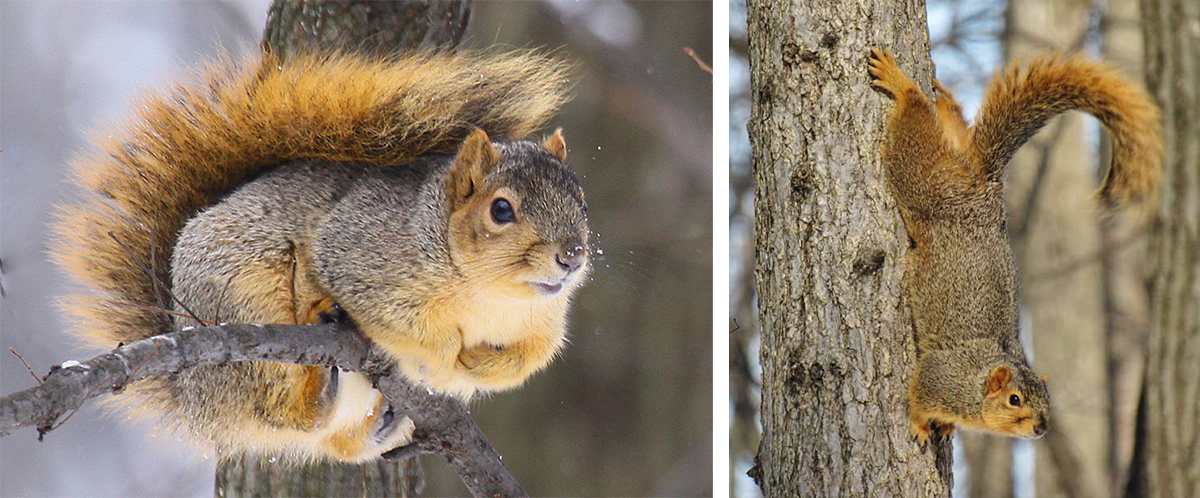
Fox squirrels weigh up to 3 pounds, with females slightly heavier than the males. Their eyes are set high upon each side of their head for a wide field of vision. They have good eyesight, even in dim light. Their ears are about three-quarters of an inch up to 1.25 inches high and are rounded. They have a keen sense of hearing. They have 20 teeth: 12 molars, four premolars, and four incisors.
Fox squirrels have numerous sets of whiskers (vibrissae), which are long and prominent. They have four toes and an abbreviated thumb on their forefeet, and five toes on their hind feet.
HABITAT AND RANGE
Fox Squirrels prefer open hardwood forests of large trees, such as oak and hickory trees in the north and coniferous tree forests in the south, both being interspersed with cleared areas. They also inhabit trees in suburbs and in golf courses. They avoid forests with dense underbrush and with closed canopies.
Fox Squirrels are found in the eastern and central United States, as far west as the Rocky Mountains. They were once common in the northeast but declined in numbers when the European settlers arrived. However, their numbers have increased in the Midwest when the settlers cleared that land. Fox Squirrels are a solitary species. Their territory covers about 10-50 acres. A single hectare may support one to seven squirrels. They can swim and can run up to 12-15mph.
DIET
Fox Squirrels primarily eat hickory nuts, oak acorns, black walnuts, butternuts, beech nuts, American hazelnuts, and pine cones. They also eat maple and yellow poplar seeds, osage-oranges, flowering dogwood berries, buds and flowers, pawpaw, wild black cherry fruit, fungi, and tree bark. They also eat animal matter, such as insects, insect eggs, bird eggs and nestling birds. They get most of their water from their food.
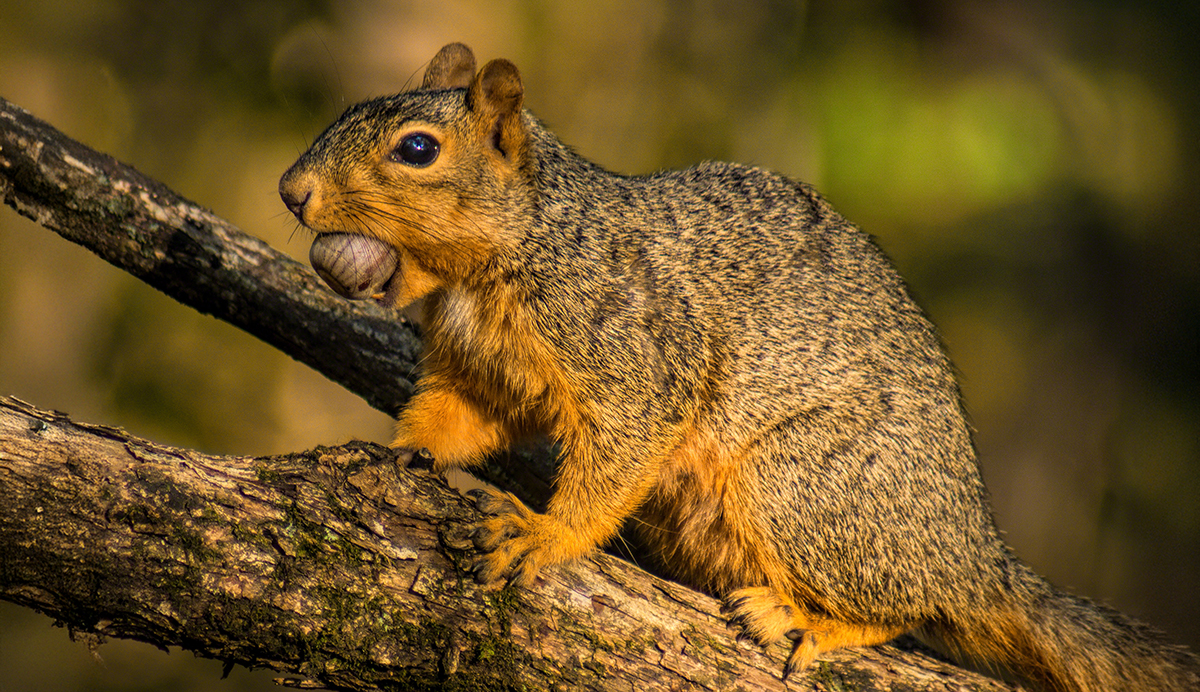
They often raid backyard birdfeeders and compete with birds for the seeds. They are quite able to overcome the anti-squirrel devices placed upon these feeders. They even raid cornfields and damage the crops. They often remove the cobs and eat the entire kernels from the cobs. They may travel far from their trees in search of food, especially in fall. They often forage upon the ground. They forage most of the day and even on moonlit nights. They usually carry their food to a favorite perch, such as a low branch, log, or stump, for consumption. These eating perches are often littered with discarded nutshells.
Fox Squirrels are scatter hoarders. They often bury the nuts and acorns singly or store them in large piles inside hollow trees. The squirrels will later find these buried nuts and acorns through smell, not memory. They can detect them in 2 inches of soil or in 12 inches of snow.
About 99% of these cached nuts and acorns are found and retrieved. Those that are not found and retrieved may germinate and sprout new trees. Some of these nuts and acorns may have had their germinating ends nipped and cannot germinate. However, these squirrels help regenerate new trees for future use.
VOCALIZATION
Fox Squirrels emit various barks, coughs, grunts and churrs. They emit a series of barks and chatters when alarmed or distressed. These sounds are like chuck-chuck-chuck or que-que-que. They may emit whines and screams during courtship. They also make loud chewing noises when eating.
NESTS
Fox Squirrels prefer to nest in tree cavities, especially those made by pileated woodpeckers. An ideal area may have one or two tree cavities per acre. Their tree cavities are about 6 inches wide, about 14-16 inches deep, and have an opening of between 3 and 5 inches.
They also build nests upon tree branches and crotches. These nests are made of twigs, grasses, leaves, moss and other plant materials. These nests have an outside diameter of about 12-24 inches and an inside diameter of about 6-8 inches. They have one entrance. During summer, they also build smaller flat nesting platforms. Both sexes build these nests. They prefer white oaks and American chestnuts for their nesting trees. These nests are located at least 30 feet above the ground. They often use between three and six different nests. They nest solitarily in the tree nests in the summer and colonially in the tree cavities in winter.
BREEDING
Depending upon the latitude, breeding season is usually December to February and May to July. During this time, several males may pursue a single receptive female, sometimes for several days. The yearling females will have one litter per year and the older females will have two.
Gestation is about 44 to 46 days and each litter has about one to seven young. The females often move their young around to different nests to avoid bad weather, predators and parasites. These pups are born blind and hairless with pink and purplish skin. They are about 5 inches long and weigh about half an ounce to three-quarters of an ounce. After two weeks, they grow their fur. After four to five weeks, their eyes open. After eight weeks, they are weaned. After 10-12 weeks, they may wander from the nest. The males do not care for their young.
THREATS
Fox Squirrels have numerous predators, including several species of hawks and owls, great blue herons, black rat snakes, red and gray foxes, coyotes, bobcats, raccoons, Virginia opossums, weasels, and domestic dogs and cats.
They also suffer from external parasites, such as chiggers, fleas, lice, ticks, bot flies and sarcoptes mites. Internal parasites include pinworms, roundworms, tapeworms and protozoans. Fortunately, many internal parasites aren’t a major problem because acorns have tannin, which is toxic to them.
Fox Squirrels are a nuisance species. Aside from raiding gardens, croplands and bird feeders, they get into houses and chew up the electrical wires and other soft materials. They also get into electrical transformers and cause local power outages.
Great article, thanks Gordon!!