
TIFFANY GUO
Guest Blogger
If you’ve ever followed up a trek along Highbank’s shale bluff by wandering around the nature center, you may have come across what looks like the mounted remnants of an ancient, monstrous sea creature in the otherwise quaint surroundings. This is the jawbone replica of Dunkleosteus terrelli, a bony fish dating back to The Devonian Period, around 400 million years ago. Nestled right in the middle of the Paleozoic Era before the time of dinosaurs, this period is known fondly as the “time of fishes” for its abundance of strange, rapidly-diversifying sea creatures. Ohio was then a shallow sea, a reservoir of ancestral fish that preceded those we know today.
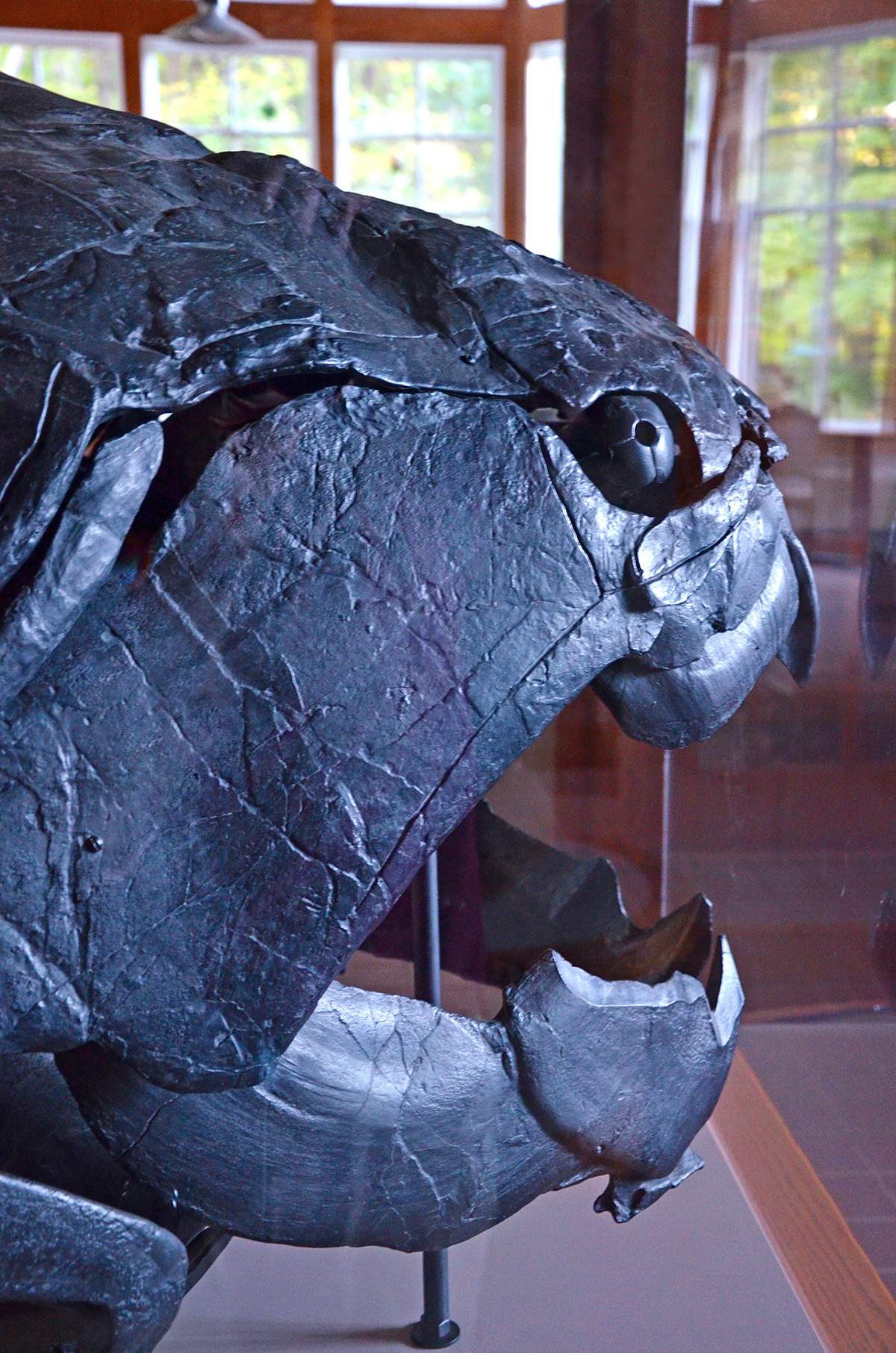
In its time, Dunkleosteus terrelli was likely the largest and most undefeatable animal to have existed in Ohio.
To this colossal predator, the world was land (or sea) to be conquered. Part of its terrorizing nature was ascribed to its bite. Despite lacking traditional teeth, its mouth could open in twenty milliseconds, creating a strong vacuum force that swept prey between its jaws. These jaws featured two razor sharp slabs, one protruding from the top and the other from the bottom, engineered by evolution to slice through bone- they snapped shut in as little as sixty milliseconds, ambushing its prey with enormous bite force almost too quickly for the human eye to have registered. Each time it opened and shut its mouth, the jaws would scrape against each other, one blade automatically sharpening the other. The efficient combination of both opening and shutting the jaws, along with brute bite force, is typically unheard of- most top predators are advantaged in either efficiency or power, but not both to this extent. This is the criterion that enabled Dunkleosteus terrelli to monopolize its oceans, crowning it as not only an apex predator, but the first of its kind to grace the state of Ohio.
Interestingly, Dunk’s weapon of a mouth belies the rest of its form, which was notably less intimidating. Looking at the monstrous fish in its entirety, we see its mouth contrasted with a more vulnerable body, consisting entirely of soft cartilage. Accordingly, Dunk belonged to a group called the Placoderms; placoderms (meaning “plate” and “skin” in Greek roots) had heads of bony plate and cartilaginous bodies, appearing in sizes from 10 centimeters to 10 meters long.
As you find yourself in front of Dunk’s jawbone in the Highbanks nature center, you might come across another placoderm replica in the grand meeting room. These are the remains discovered inside a concretion at Highbanks in the 1980s, not belonging to Dunk but a fish that resembled it with similar bony plates of armor and jaws of jagged blade, called Dinichthys terrelli. Although occupying its own separate clade, Dinichthys terrelli was another apex predator placoderm that lasted until the end of the Devonian period, observed today only in fossil form.
In general, the placoderms remain somewhat of a mystery. Even in current scientific research, estimates of Dunkleosteus’ specific size usually fall between ten and thirty feet – a generous range. What complicates size estimates further is that much of the placoderm’s bodily form is incomplete in the fossil records. This is partly because cartilage, which made up the body of a placoderm, is a delicate material that doesn’t hold up well in the rough hands of pressure and sediment. In order to be flexible, cartilage falls short in durability when compared to bone. It’s often too fragile to fossilize, even in ideal conditions. Dunk’s body shape and size are still a topic of debate, with recent discoveries suggesting a shorter but chunkier build, more resembling a tuna than a shark. Fossils of Dunkleosteus, like the one found at Highbanks, tend to outline only its head with its plates of bony armor, the rest of its soft body lost to time and decomposition.
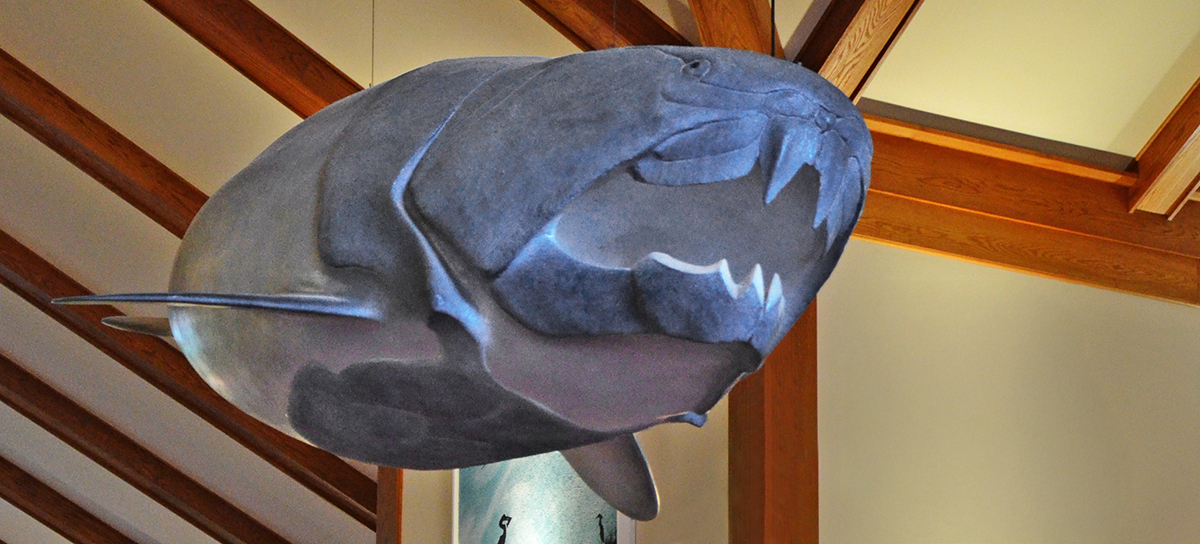
It’s especially true in the animal world that even the fiercest monarchies must come to an end. As indestructible as Dunkleosteus terrelli was in its lifetime, in death it was eager to decay-and decay it did, as the Devonian Period’s last years saw mass marine extinctions due to reasons still debated among experts. Leading theories of Devonian extinctions include grand volcanic eruptions and plunging oxygen levels in the sea due to the explosion of algal blooms, which pull massive amounts of oxygen from the water as they decompose. Either way, Ohio’s first apex predator’s grip on the seas loosened with age as the Devonian period fell victim to a changing planet, before new underwater dynasties would reign in the Carboniferous period. The extinction of Dunkleosteus terrelli is a testament that even an animal of such reigning terror is not immune to the elements, either in body or fossil. Despite this, perhaps extinct creatures continue to exist as trapped in time, the way amber hardens to preserve a specimen. Perhaps, as our first apex predator was laid to rest by the water itself, it sank to the seafloor and was immortalized by, if not fossil, the mystique of its remnants and the glory of its title.
Wow! Great history lesson!